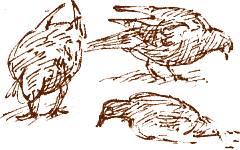
IT’S SO WINDY here at North Landing, Flamborough, East Yorkshire, that even the gulls are having difficulty making any progress inland; a gull version of Marcel Marceau’s ‘walking against the wind’ mime. A flock of pigeons is no more successful; they wheel around over the bay and veer off on a less wind-buffeted course.
Flamborough Head marks the border between sea areas Tyne and Humber, pointing out towards Dogger in the centre of the North Sea and German Bight on the far side.
Strong winds tend to bring seabirds in towards this six mile promotory of chalk cliffs, making it a favourite location for ‘seawatching’ but unfortunately today it’s blowing in the wrong direction. If it’s blowing from any direction between north-west and east it can bring gulls and auks, skuas and shearwaters closer to the shore but today it’s blowing from the south-west, tending to keep them out at sea.
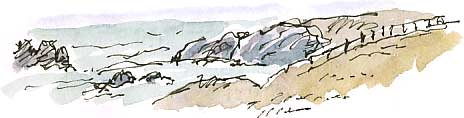
You might expect to a lot of white-topped waves in such a strong wind but it seems to have the opposite effect, flattening the crests before they become top heavy. At the foot of the cliffs there’s an effect like beaten brass where gusts bring turbulence down to create temporary patches of smoother sea.
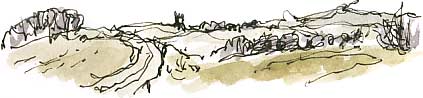
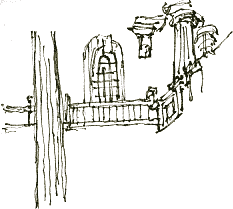
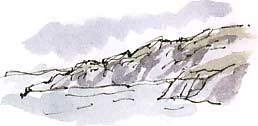
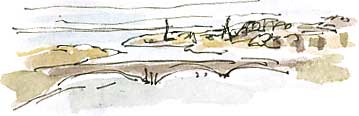
As a change in my watercolour of the cliffs, I started directly with my brush, with no preliminary drawing, painting the shapes of sky, cliff-top and sea separately, as if they were individual pieces of a jigsaw. A contrast to my habitual pen plus wash, which I used in my quick sketch of Howden Minster on our coffee break on the way here this morning.
I’VE DRAWN these Desirée red maincrop potatoes with a size no. 111 Tower Pen nib that I used when I drew my new art-bag the other day in non-waterproof ink; a sepia calligraphy writing ink from the Manuscript Pen company of Highley, Shrophshire. This flows more smoothly than Indian ink but the disadvantage is that I don’t now have the option of adding a watercolour wash to my drawing – not unless I’m prepared to see my line-work run unpredictably into the watercolour, which in this case is not the effect that I’m after.
I’m in a mood where I yearn for a bit of inky precision in my life after what has often seemed like a long nebulous period.
Chitting
I’m chitting these Desirées; this involves leaving the tubers in a light, airy but not too warm place to encourage the growth of sturdy new sprouts from the eyes of the potato. While this isn’t essential for a maincrop variety it is a way of celebrating the stirring of new life and the welcome return of spring.
THE REAR WINDOW of our apartment on Glassford Street, Glasgow, where we stayed last weekend, looked out over a yard. The wall of the adjoining building was constructed of rough-hewn stone and I noticed these fossil ripple-marks in two of the blocks.
The nearest that I’ve seen to this type of rock is the light grey Carboniferous limestone of the Yorkshire Dales, although you can see that one of the blocks (lower right) has a warmer, sandy colour.
Quarries in Bishopriggs, 3 or 4 miles to the north, supplied a pale golden brown sandstone from the Carboniferous limestone formation (locally classified as the Clackmannan Group) which was used in the construction of Victorian Glasgow, so perhaps these ripples formed in a tropical lagoon 320 million years ago, when Glasgow lay close to the equator.
WHEN CHECKING out my Middleton Park route for Walks in the Rhubarb Triangle, I was intrigued by the sign for a cycle-path route to the centre of Leeds.
‘How long will it take?’ Barbara asked, sceptically.
‘Oh, by the time we’ve walked down through the woods, it will only be about another ten minutes.’
Dog’s Mercury
It turned out to be more like another hour, but it’s still a walk that I’d do again as I like the way it follows ribbons of green to heart of the city. Once you’ve walked down from the park lake through Middleton Woods, you follow the line of the Middleton Railway then pass under the motorway to its depot, passing a line of rusting tank engines. You then go alongside a playing field before following a busy dual-carriageway for half a mile. Thankfully it’s not too long before you dip down to a quiet path alongside the River Aire to reach the city via Clarence Dock and the Royal Armouries.
Woodland Flowers
Coltsfoot
It’s the first day of spring but it seems more like summer this afternoon. Woodland flowers are showing; the odd clump of delicate Wood Sorrel holds its clover-like leaves folded back. The the banking beside the path is dotted with Lesser Celandine and green swathes of Dogs Mercury. The leaves of Bluebells are already showing. As we approach Leeds the rough ground beside the path is dotted with Coltsfoot.
THE TROUBLE with having a big cut-back in the garden is that you end up with a big pile of trimmings, but it isn’t quite as bad as it looks; two thirds of that pile is material from the old compost bins (right) which I now need to put back in the new, much-improved version which we’ve constructed behind the greenhouse.
Now would be a good time to start a crop of mixed salad leaves in the greenhouse, which we’d take out in about two months time when the tomato plants will go in.
I should also be able to whittle down the quantity of black plastic water-tanks that are lying around at the end of the garden; the existing water-butts connected to downpipes from the roofs of the house, the greenhouse and the shed should provide enough rainwater for all but the driest summers.
IT SEEMED rather drastic when, a few years ago, spiked fences went up around the old colliery railway embankment that crosses the valley floor between the canal and the river at Addingford. It blocked off an unofficial walk that I had enjoyed since the tracks were taken up in the late 1960s and, alarmingly, a number of Silver Birches were chainsawed and left lying where they fell, but from the official public footpath, which runs along the foot of the embankent, I can now see this from the birds’ point of view.
The fence, I realise, isn’t designed to keep humans out; well it does keep them out but whoever put up the fence has gone to a great deal of trouble to ensure that the four-legged friends of humans can’t get in there to enjoy snuffling around in the undergrowth. Bad news for dogs but good news for ground-nesting birds.
Even the felling of a dozen birch trees isn’t necessarily a disaster for wildlife; it has opened up sunny spaces on the banking which should encourage the growth of wild flowers, which in turn should attract butterflies. Ants should also be active on this sunny slope which provide food for a bird that I’ve seen for years near the old railway; the Green Woodpecker.
Leaving the birch trunks where they fell also makes good sense; dead wood is so often cleared away from public spaces and forestery plantations, removing a potential habitat for all sorts of wildlife.
I noticed that several of of the birch trunks, sawn off at chest-height, which is not the approved way to coppice them, have been adopted as bird feeding stations by having planks nailed to them. The resident Robins seemed happy with this arrangement.
The fenced-off embankement wouldn’t walk away with the gold medal for a wildlife garden at Chelsea but as far as habitat goes it’s shaping up to be an improvement for birds, butterflies, wild flowers and fungi.
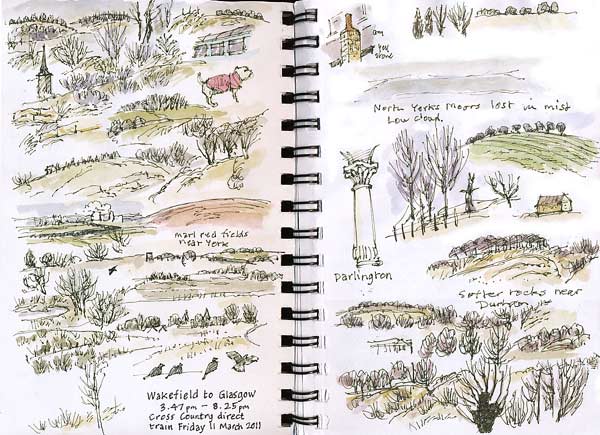
AFTER OUR WEEKEND trip to Glasgow we returned to Wakefield Westgate station exactly 48 hours after we set out. Travelling by train gave me a rare chance to sketch, so here are yet more drawings from our travels that I wasn’t able to fit into my last posting. I couldn’t have done much drawing if I’d been driving but the main reason that I was able to be so productive – in terms of sketchbook pages – was getting away from the distractions of home life and running a business.
Dark Angel
It’s a 4½ journey but on the way out the daylight only lasted for the first hour and a half or so, about as far as Durham, so the grim outline of the Angel of the North was the last thing I drew. He doesn’t look like an angel about to take flight. I’d hate to look out each morning on such a doom-laden figure, weighed down by his iron wings, which are surely shackles of imprisonment rather than a means of soaring to escape. It seems churlish to say that I’d rather look out on a utility than a work of art but the pylon that stands in the field above the wood is light and airy in comparison with this grim apocalyptic figure.
Early Start
On the return trip, looking around for something to draw at Glasgow Central station, I had a wobbly attempt at the Uppercrust refreshment booth. It often takes me a while to get started in the morning. I don’t always feel like bursting into a drawing, especially when I’ve got a train to catch which makes me feel unsettled, but doing some kind of drawing is better than doing none at all.
It gets me started.
The pigeons coming down for scraps of sandwiches were a better warm-up than those tricky parallel curves of the sandwich booth.
At our stops at York, Edinburgh Waverley and Newcastle, the cast iron pillars seemed the obvious subject to draw. As in all the other views from the carriage window, I added the colour later. There’s hardly the time to draw a tree or building as we hurtle past, let alone add colour, so the drawings are from one landscape, the colour from another, or from memory.
Wild Tracks
I drew these cattle and sheep as we crossed through the Scottish borderlands, heading for Berwick on Tweed. Where the line runs close to the cliff-top, we looked out for seals in the rocky bays below. No seals and we didn’t see much in the way of wildlife at all so to spot a woodpecker as we sped along was a bit of a bonus.
Barbara thought it was a green while I thought it was great spotted but we both agreed it was a woodpecker from its size and its bobbing flight as it crossed an open field, heading away from a nearby copse.
The motion of the train makes for a jerky pen line.
As we came back into Yorkshire, the North Yorks Moors loomed above the farmland. They’d been almost imperceptable in the mist on our outward journey, their tops hidden by a long low cloud.
IT SEEMS as if winter has lasted six months but although almost all the trees are still stark and bare there’s a feeling that the landscape is at last about to burst into spring. In Scotland snow lies on the tops and in gullies on distant hills, in the pattern you get when you pour double cream over a pudding. On lower ground in the Midland Valley it lies in random swathes, as if snow showers had been localised over particular slopes. I don’t think this was due to overall snowfall melting in patches because some of the slopes that have retained snow are – if I’d got my bearings right – south-facing.
On the calm waters of a loch, a few anglers are fishing from rowing boats. It looks like a clip from a ‘Discover Scotland’ commercial and I’m surprised that it can look so wild and open in the country between Glasgow and Edinburgh.
St Andrews in the Square
We’re in a Glasgow for a wedding in the airy nave of St Andrews in the Square, restored to its 18th century splendour a few years ago. Bonnie Prince Charlie saw this church being built in 1745 when his army camped here on their retreat from their failed invasion of England.
At that time ‘tobacco barons’ were bringing wealth into the city and this is reflected in the confident elegance of the church with its Corinthian capitals.
As we took a taxi back to Central station I was saying that I would have liked to have seen this interior with the light flooding in on a sunny day but the taxi driver told me that he’d been to a summer wedding there; it was the first time he’d worn a kilt and he found that it got very warm in there when the sun gets out. Another taxi drive explained that the sun gets out on only one day of the year in Glasgow, so that’s not such a problem for the venue.
Unfortunately this turned to be a white wedding with snow falling all morning. Barbara and I were hoping to have some time to explore the city but we hadn’t brought our fell-walking waterproofs, so we’re going to have to return to do that.
From our apartment on Glassford Street, I started drawing the building opposite but just as I got to the most interesting bit – the ornate shop-front of the Blane Valley bar – I had to break off. From our first floor window across the street I was seeing the building in 3 point, or rather 4 point, perspective, as I was looking both up, down and sideways on it, but I tried to straighten up what I was actually seeing into an architectural elevation. If I’d had time I would have gone on to add the next building, Coral Bookmakers.
East Coast
These days, it can prove to be a bit of an adventure getting my mum to the co-op once a week so I insisted that, if she was going to travel with us, we should take the through train (there are two a day from Wakefield right through to Glasgow) and, for the first time ever, go for the roomier seats and the complimentary light refreshments of First Class. I could get used to it and I want to try it again soon!
There’s no restaurant car on the East Coast route and the chefs are given the weekend off but even so the highlight of the return journey for me was lunch, served at our table from the limited weekend menu. Eating a vegetable curry as I watch the wild coast of Northumbria going by comes pretty close to the perfect dining experience!
I felt the need to do an inky drawing: a new nib, a new wooden pen holder and an old bottle of Indian ink, only a quarter full and turning lumpy. I bought the new bag in Marks & Spencer’s in Glasgow at the weekend. The excuse was that I needed a new one to match my outfit!
Black strikes me as a good colour for an art bag, especially if I’m tempted to go back to dip pen and Indian ink, as the odd spill won’t show. It was labelled as ‘Fisherman bag’ and made from oiled cotton, which should be water and stain resistant.
Leaning against the window ledge in my drawing, it appears square but in fact my A4 sketchbook fits snugly inside the main compartment. There are sufficient smaller pockets – six in all – to take my basic kit of art materials and other bits and pieces.
Link: Pure Cotton Cross Body Bag on the M&S website; there’s even a video of a bearded man on a remote Californian (?) road modelling a brown version of the bag and looking as if he’s wondering when the next bus will come along. Perfectly illustrates the sort of adventures I have in mind when I set off along the trail with my new art bag.
This Barn Owl was found lying by the side of the M1 near junction 40 earlier this week. A member of the Wakefield Naturalist’s spotted it and brought it to the meeting on Tuesday. Sadly, this if a first; at the meetings of the Wakefield Naturalists’ Society that I’ve attended over the last 40 years, I don’t ever remember anyone bringing in a dead bird but this was apparently a regular feature of the society’s meeting in the Victorian period in the bad old days when one of the axioms of keeping biological records was ‘what’s hit is history, what’s missed is mystery’. Even some of the founding fathers of conservation like Audubon used the gun to collect huge numbers of birds, and not just strictly for reference purposes when illustrating his Birds of America, he apparently enjoyed the sporting aspect of shooting wild birds.
There’s a record of an Otter which was shot on the Calder at Stanley on 3 February, 1869. Rather worryingly there’s a note in the Wakefield Naturalists’ Society Annual Report for 1883 (illustrated here with an engraving by Thomas Bewick, or one of his followers):
Otter – Lutra vulgaris. Several have been obtained.
The Wakefield Naturalists’ Society was founded in 1851, ten years before the Yorkshire Naturalists’ Union, which celebrates its 150th anniversary with a conference on The Ever-changing Flora and Fauna of Yorkshire at Garforth on 19 March this year. Obviously there had to be a network of naturalists’ societies before a county-wide Union could be formed.
Coming back to the unfortunate Barn Owl; it’s hunting habits, flying low over open, scrubby grassland, in the half-light of evening are sooner or later going to put it on a collision course with motorway traffic. Low Laithes golf course provided a hunting territory for Barn Owls as their numbers began to recover locally in the 1980s. They’re continuing to spread around Anglers Country Park today.
Appropriately the place name Laithes comes from the Viking word for barn. My Walks around Ossett follow circular routes around the town from Mitchell Laithes in the south-east to Low Laithes in the north-west.
When I was checking out the Low Laithes walk for the booklet, I came across a familiar-looking image of a Barn Owl. Flags and signs at Low Laithes golf course are emblazoned with the owl logo I drew for them back in the late 80s or early 90s. It’s even been carved in bas-relief in sandstone by the entrance gates; the first time I remember anything of mine being carved in stone.
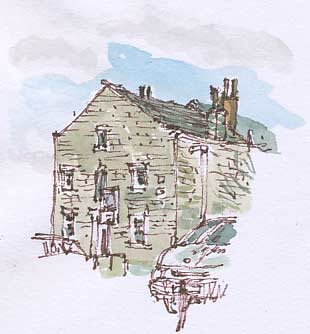
End of terrace on the junction of New Street and Prospect Road, Ossett, drawn during a coffee break at Cafe Vie.


 As a change in my watercolour of the cliffs, I started directly with my brush, with no preliminary drawing, painting the shapes of sky, cliff-top and sea separately, as if they were individual pieces of a jigsaw. A contrast to my habitual pen plus wash, which I used in my quick sketch of Howden Minster on our coffee break on the way here this morning.
 I’VE DRAWN these Desirée red maincrop potatoes with a size no. 111 Tower Pen nib that I used when I drew my new art-bag the other day in non-waterproof ink; a sepia calligraphy writing ink from the Manuscript Pen company of Highley, Shrophshire. This flows more smoothly than Indian ink but the disadvantage is that I don’t now have the option of adding a watercolour wash to my drawing – not unless I’m prepared to see my line-work run unpredictably into the watercolour, which in this case is not the effect that I’m after.
 THE REAR WINDOW of our apartment on Glassford Street, Glasgow, where we stayed last weekend, looked out over a yard. The wall of the adjoining building was constructed of rough-hewn stone and I noticed these fossil ripple-marks in two of the blocks.
 Dales, although you can see that one of the blocks (lower right) has a warmer, sandy colour.
 WHEN CHECKING out my Middleton Park route for Walks in the Rhubarb Triangle, I was intrigued by the sign for a cycle-path route to the centre of Leeds.

 It’s the first day of spring but it seems more like summer this afternoon. Woodland flowers are showing; the odd clump of delicate Wood Sorrel holds its clover-like leaves folded back. The the banking beside the path is dotted with Lesser Celandine and green swathes of Dogs Mercury. The leaves of Bluebells are already showing. As we approach Leeds the rough ground beside the path is dotted with Coltsfoot.
 THE TROUBLE with having a big cut-back in the garden is that you end up with a big pile of trimmings, but it isn’t quite as bad as it looks; two thirds of that pile is material from the old compost bins (right) which I now need to put back in the new, much-improved version which we’ve constructed behind the greenhouse.
 Now would be a good time to start a crop of mixed salad leaves in the greenhouse, which we’d take out in about two months time when the tomato plants will go in.
 I should also be able to whittle down the quantity of black plastic water-tanks that are lying around at the end of the garden; the existing water-butts connected to downpipes from the roofs of the house, the greenhouse and the shed should provide enough rainwater for all but the driest summers.
 IT SEEMED rather drastic when, a few years ago, spiked fences went up around the old colliery railway embankment that crosses the valley floor between the canal and the river at Addingford. It blocked off an unofficial walk that I had enjoyed since the tracks were taken up in the late 1960s and, alarmingly, a number of Silver Birches were chainsawed and left lying where they fell, but from the official public footpath, which runs along the foot of the embankent, I can now see this from the birds’ point of view.
 does keep them out but whoever put up the fence has gone to a great deal of trouble to ensure that the four-legged friends of humans can’t get in there to enjoy snuffling around in the undergrowth. Bad news for dogs but good news for ground-nesting birds.
 Even the felling of a dozen birch trees isn’t necessarily a disaster for wildlife; it has opened up sunny spaces on the banking which should encourage the growth of wild flowers, which in turn should attract butterflies. Ants should also be active on this sunny slope which provide food for a bird that I’ve seen for years near the old railway; the Green Woodpecker.
 Leaving the birch trunks where they fell also makes good sense; dead wood is so often cleared away from public spaces and forestery plantations, removing a potential habitat for all sorts of wildlife.
 I noticed that several of of the birch trunks, sawn off at chest-height, which is not the approved way to coppice them, have been adopted as bird feeding stations by having planks nailed to them. The resident Robins seemed happy with this arrangement.
 The fenced-off embankement wouldn’t walk away with the gold medal for a wildlife garden at Chelsea but as far as habitat goes it’s shaping up to be an improvement for birds, butterflies, wild flowers and fungi.


 The pigeons coming down for scraps of sandwiches were a better warm-up than those tricky parallel curves of the sandwich booth.


 As we came back into Yorkshire, the North Yorks Moors loomed above the farmland. They’d been almost imperceptable in the mist on our outward journey, their tops hidden by a long low cloud.