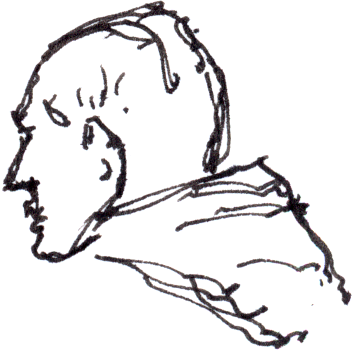
This feels like getting back to some kind of normality: sitting with a latte at a table outside Bistro 42 overlooking Ossett’s Friday market and watching the world go by. I want to just draw what is in front of me rather than, as I often do, taking a mental snapshot of a passing figure, so I draw people who look as if they might stay in position for a few minutes. The men waiting on the bench are the most obliging. I find back views expressive. Rather than slapping a facial expression on a character, you can leave the viewer to work out for themselves whether a character is feeling relaxed or slightly; tense, bored or curious.
This marginal illustration for one of my Dalesman diaries isn’t meant to be a trail map but you couldn’t go far wrong in finding your way to Danes Dyke Nature Reserve than starting at the harbour and keeping the sea on your right. Look forward to walking it again some time. And, when they come out of lockdown, there’s always the option of catching the Land Train at Sewerby Hall to get back to the harbour in time for fish and chips.
These grasses and the clump of geranium by the pond reminded me of the sort of subject that Frederick Franck would draw in his book The Zen of Seeing, so I decided on a change from my usual pen and colour wash and I’ve stuck with line only. Typically Franck would add a hint of tone by dabbing parts of the drawing with a wet brush or finger tip. I can’t do that as I use waterproof ink.
I had to accept that I wasn’t going to be able to pin down this subject as the grasses were swishing around in the breeze.
The Yorkshire Wildlife Trust’s Creature Count is underway this weekend, getting people to count as many species as they can in their gardens. Here are some of the usual suspects that I would now be rounding up, if I’d signed up for the survey this year, but I’m a bit pressed with work in the studio. Must try and join in if they run it next year.
You drive down through what feels like a factory yard, cross a small swing-bridge over the canal then cross the River Aire via a century-old 38m long Pratt truss steel bridge to reach a low-lying area of lagoons and meadows, enclosed on three sides by a meander of the river, so that being on the reserve feels like being on an island. We’re actually on the inner side of the busy Leeds Ring Road, but I feel as if I’ve got a long way away from all that rush.
As a change from my usual approach, I thought I’d launch straight into watercolour for this sketch – no pen, no pencil – which is based on a panorama that I took from one of the hides on a Wakefield Naturalists’ Society field meeting at the reserve in August this year. No field meetings at all this year, which is probably a first for the Nats since the end of World War II.
This is the header image for my August Wild Yorkshire nature diary in The Dalesman.
There’s a background buzz of bumble and what look like honey bees amongst the flowers fo these broad beans. A song thrush sings from nearby bushes. Yesterday afternoon there was a bit of drama as a crow chased a jackdaw away from the ash trees at the edge of the wood – perhaps the crows have a nest there.
It droops like oats and it has long awns like barley. As this is growing at the edge of a wheat field, I’m guessing that it is great brome, Anisantha diandra, although there are some similar-looking species. Great brome is a grass from the Mediterranean region which grows on waste ground, roadsides and field edges.
The Wikipedia reports that it, and a similar brome, also get referred to as ‘ripgut brome’ in some parts of the world, where the species have become troublesome weeds.
This morning’s visit to Alverthorpe Meadows, six miles from home, is the furthest that we’ve been since lockdown began nine weeks ago. We’re meeting up with our friends, or rather Barbara is meeting with Sue and I’m meeting with Roger, as one-to-one with social distancing outdoors is as far as we’ve got in England with the easing of restrictions.
Wrenthorpe Park and the adjoining Alverthorpe Meadows are good for social distancing as there’s plenty of space and most of the paths are wide. Roger and I head up the slope. As we walk by a nestbox on a London plane tree, a blue tit pops out.
Along the top path, close to the railway, I record a blackcap singing. There’s another bird in the recording but we didn’t identify it. We later get a good view of a blackcap singing from the top branches of a willow in a hedgerow near the settling ponds.
Blackcap in woodland at Wrenthorpe Park, 10.23 a.m.
A young white poplar in the wood has rows of diamond-shaped scars on its bark. The Collins Tree Guide describes white poplar as ‘the whitest tree in the landscape’.
My friend Roger remembers when the wood was planted during the restoration of the landscape here, twenty or thirty years ago. The wood has established itself well but he feels that it needs some management now so that some of species that were planted can continue to thrive. For instance, he thinks that the hazels might get shaded out at the tree canopy closes in.
Alverthorpe Meadows
We walk down the slope crossing Balne Beck and through a belt of trees to the central meadow.
Elder is now in flower and a pink-flowered hawthorn is still hanging onto its blossom.
In the meadow, flowers of yellow rattle are dotted about amongst the buttercups and the red clover.
Pignut is also in flower and, in a damper area near the ponds, marsh orchids are starting to show.
Growing alongside the orchids, I think that this grass is foxtail, Alopecurus pratensis. Timothy grass, also known as cat’s-tail, is very similar but it flowers a bit later than foxtail.
Common sorrel, Rumex acetosa, was a popular vegetable in Tudor times and was used to make a fish sauce.
This speckled wood was sunning itself on the leaf of a hazel down by the stream. We saw several of them in the dappled shade of woodland edge habitats, along with a few white butterflies. There are extensive nettle patches but Roger commented that there were no signs of damage from caterpillars. The tops of the nettles were slightly wilting but that was because of the morning sun.
A post about the Hartley Bank Colliery mineral railway on the Horbury and Sitlington Facebook page today prompted me to go up into the attic to look out this spread from the spring of 1962. This must have been the first time that my brother Bill and I explored so far in Addingford, with our friends, the Cassidy brothers, Steven and David. We dressed for the occasion, armed with a couple of garden canes and with two of us wearing World War II tin hats.
My Exercise Books from 1960 to 62.
I’m glad still to have these exercise books, but unfortunately they don’t often take a diary form like this: I was more likely at that time to be turning the latest Biblical epic into a cartoon strip. I drew hundreds of Roman soldiers. Having said that, I have a complete run of diaries from my Grammar School years.
“It may not have been a long walk we went on but when we were back we had the benefit of playing commandos and learning how to swing on trees, seeing frogs mating, toads and a canal salvage boat in action.”
My summing up of the ramble (spelling corrected), spring, 1962
I don’t mention it in my comic strip but ‘learning how to swing on trees’ reminds me of an occasion, perhaps later that day, when all four of us were swinging over a water-filled ditch by the canal near our ‘Frogtown’. I ended up in the water and stormed off back home on my own, blaming Steven for my downfall.
The canal near Horbury Bridge, this morning.
Notes on the Panels
Panel 1: Gathering together at the end of our driveway, Smeath House, Jenkin Road, Horbury. Our family lived in the ground floor flat, the Cassidys in the first floor.
Panel 2: Setting off via Grove Road, crossing Westfield Road and down Addingford Lane (the A642 Southfield Lane Horbury bypass was constructed a few years later).
Panel 3: Addingford Drive hadn’t been built at the top of the slope, so the woods and scrub alongside Addingford Steps, with steep paths running through them were ideal for a game of commandos.
Panel 4: Crossing the bridge over the railway, the footway alongside the Hartley Bank mineral railway and the bridge over the canal at the foot of the Balk.
Panel 5: The open-ended shed is one of the coal loading bays alongside the canal at Hartley Bank Colliery.
Panel 6: Repairs to the canal. They did a good job: over half a century later, these interlocking steel sections are still holding up this section of the canal bank.
Panel 7: Steven.
Panel 8: Welder at work, note the goggles.
Panel 9: I think that this is my brother striding by in the foreground with long socks, short trousers and yellow pullover.
Panel 10: ‘Frogtown’, a notch cut in the canal bank to allow coal barges using the British Oak loading chute to turn around. This effectively cut off a stretch of a public right of way. The route of the footpath is still marked on the OS map but, 60 years later, the route hasn’t been reinstated.
The card shops and National Trust gift shops have yet to reopen so I’m still producing homemade birthday cards, this one celebrating a birthday and a very successful bee hotel. The day our friend John Gardner finished constructing it and put it in place, several solitary bees moved in.
Meanwhile the numerous cats who wonder through our back garden provide material for cards, including these two characters. When it came to a showdown, ‘Bear’ through bluster and body language had no trouble seeing off the smaller ‘Wildcat’ tabby.