A COMMOTION before breakfast; six Blackbirds and a Mistle Thrush are gathered in what looks to me like indignant rage around a Magpie on the back lawn which is down at the edge of the pond, attacking a plump nestling, pecking at its head. I know that I should no more wish that Magpies wouldn’t take the chicks from ‘our’ back garden nests than I should wish that Osprey’s shouldn’t swoop on trout or that lions shouldn’t attack zebras but it’s difficult not to feel involved as this turns out to be chick from a Blackbird’s nest in the Ivy behind our herb bed.
 We’ve been following the progress of the parents’ nest-building and feeding from the kitchen window, only yards from the nest. They’ve been busy over the past few days shuttling in a supply of worms and insects.
 Deciding that it would be too late to rescue this chick anyway, I leave the garden birds to sort it out between themselves.
But, after breakfast, when I go down the garden to open the greenhouse, I discover a second chick. It looks like a miniature oven-ready chicken, naked, plump and bleary-eyed, with a row of plastic-looking quills along its stubby wings. Only it’s parents could love it. It’s got a spot of blood near the base of its bill but is otherwise unscathed. The Magpie must have been disturbed before this chick suffered the fate of its sibling, which the Magpie carried off down to the vegatable beds to finish eating.
 I put my head into the Ivy and with some difficulty spot the nest, on a twining branch on the far side of the hedge. With a stick I poke away the remains of a third chick, hanging over the nest from a twig, which the Magpie had evidently killed in its attempt to make off with it.
I retrieve the surviving chick from the lawn and place it so that it’s as comfortable as it can be in the nest. It’s still warm and, I guess, healthy enough.

 I’m anxious that the parents will have desserted the nest but by the end of the afternoon they’re back again, so it looks as if they’ve found the youngster. A day later male and female are still taking turns to pop in with food so it looks as if the Magpie hasn’t been back . . . so far.
 I’VE DRAWN these Desirée red maincrop potatoes with a size no. 111 Tower Pen nib that I used when I drew my new art-bag the other day in non-waterproof ink; a sepia calligraphy writing ink from the Manuscript Pen company of Highley, Shrophshire. This flows more smoothly than Indian ink but the disadvantage is that I don’t now have the option of adding a watercolour wash to my drawing – not unless I’m prepared to see my line-work run unpredictably into the watercolour, which in this case is not the effect that I’m after.
 THE TROUBLE with having a big cut-back in the garden is that you end up with a big pile of trimmings, but it isn’t quite as bad as it looks; two thirds of that pile is material from the old compost bins (right) which I now need to put back in the new, much-improved version which we’ve constructed behind the greenhouse.
 Now would be a good time to start a crop of mixed salad leaves in the greenhouse, which we’d take out in about two months time when the tomato plants will go in.
 I should also be able to whittle down the quantity of black plastic water-tanks that are lying around at the end of the garden; the existing water-butts connected to downpipes from the roofs of the house, the greenhouse and the shed should provide enough rainwater for all but the driest summers.


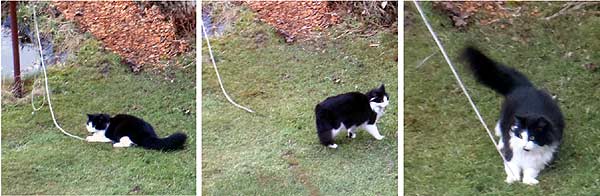
 Too much of a temptation for this black and white cat which was taking it’s usual shortcut back from the meadow via our back garden path. You can see (below) that at times it turned its back on it but then thought ‘Well, just one more go . . .’


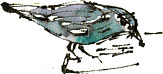
 These aren’t drawings of the birds’ ‘true’, accurate appearance – it would be easier to study a bird book for an authoritative version of that – but they aren’t drawings of the birds as I saw them either; they’re drawings of the way I remembered the
 appearance of the bird after I’d looked at it for as long as possible, which wasn’t long enough, through binoculars.