I WAS SURPRISED to see the first red Hawthorn berries this week, just odd ones, not a whole bunch as in my drawing. Most haws are still green but a few have ripened on a south-facing bush on the top of an embankment overhanging a pavement, so they’d had more warmth than most. I’ve also tasted my first Blackberry of the season and in the garden the autumn Raspberries in our garden.
On the black railings of Addingford Steps there were dozens of ladybirds, so many in one place that I had the impression that they might have recently emerged from pupae, but perhaps it was the warmth of the metal that attracted them.
Clearing Willows
There’s a patch of devastation on the marshy field known as The Strands between the river and the canal downstream from Horbury Bridge. My vague memories of this area of willows is that it started as a few willows next to a water-filled hollow and over the years grew to become a dense circular thicket. It has evidently taken a great deal of effort to clear it.
I DREW Xander the black and white cat in colour this weekend and I felt that my usual rapid sketches drawn as the train headed for London should have colour added to them too.
Instead of drawing individual trees, hedges and buildings as they flash by, I try to link them into a landscape composed of bits and pieces that may have been drawn miles – ten miles or more in some cases – apart.
By my first sketch I’ve written ‘Doncaster to Grantham’, while the second was drawn between Stevenage and Potters Bar.
Midland Landscapes
On the return journey there’s a section where the line follows an attractive lowland river for a while.
After that the landscape features rolling hills, farms and stumpy church towers with small spires. My sketch also includes a couple of sheep, a crow and a cutting through Jurassic limestone. These features were scattered across miles of trackside landscape in the Grantham area.
Finally, as we neared Doncaster, here’s a landscape of more church towers, cows and distant hills that I didn’t quite get finished. I got as far as dabbing in a grey and pale green wash. It was a dull, overcast afternoon.
A Sketchbook Underground
Until you leave the central zone, there isn’t much to see through the windows of a London Underground train. A fearless drawing journaller like Dan Price might have sketched fellow passengers in the busy train but I settled down to drawn my left hand. Again, as this is unfinished, you can see how I start off with a pale wash of grey before adding yellow ochre, sometimes with a dash of permanent magenta.
Permanent magenta is the cool red that I’ve used to replace alizarin crimson, or permanent rose or whatever else I was using in my pocket watercolour box. The thinking behind this is that magenta will be more useful for mixing the colours of wildflowers, so many of which are variations on magenta. Neutral tint recently replaced the rather acid, greeny blue version of Paynes grey that I’ve used for a decades as the grey in my watercolour box. So far neutral tint seems to work well for the natural subjects I’m keen to draw.
Finally, here are hand studies, and a handful of details drawn as they flashed by through the window, drawn between Kings Cross St Pancras and Hunslow East on the Piccadilly Line.
CHARLOTTE’S Ice Cream Parlour at Whitley, with its assortment of farm animals and its panoramic views across the Calder Valley, is a relaxing place to draw. It’s up on a ridge-top but on a windy day you can retreat to the shelter of the cafe . . . and perhaps sample the Real Jersey Ice Cream.
As well as a contented Jersey cow there are a couple of donkeys, some heavily pregnant nanny goats and rare breed sheep.
Peacocks are displaying to the peahens, a black hen is leading her brood of black chicks across the meadow and, adding an exotic touch, a couple of rheas (or are they young ostriches?) are strutting along in the paddock by the car park.
The donkeys wander over to meet visitors and indulge in a bit of mutual grooming.
I’m back to working in the Crawford & Black portrait format sketchbook – that’s the one with the 96 gsm acid free cartridge which I find a bit thin and absorbent for my pen and watercolour sketches but it will do for everyday. When I get the chance for some natural history drawing, I’ll go back to landscape format.
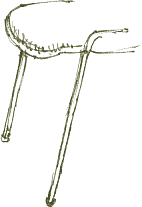
Recent snatched sketches in my ‘everyday’ sketchbook include the backs of some shops and this tubular metal chair.
This Barn Owl was found lying by the side of the M1 near junction 40 earlier this week. A member of the Wakefield Naturalist’s spotted it and brought it to the meeting on Tuesday. Sadly, this if a first; at the meetings of the Wakefield Naturalists’ Society that I’ve attended over the last 40 years, I don’t ever remember anyone bringing in a dead bird but this was apparently a regular feature of the society’s meeting in the Victorian period in the bad old days when one of the axioms of keeping biological records was ‘what’s hit is history, what’s missed is mystery’. Even some of the founding fathers of conservation like Audubon used the gun to collect huge numbers of birds, and not just strictly for reference purposes when illustrating his Birds of America, he apparently enjoyed the sporting aspect of shooting wild birds.
There’s a record of an Otter which was shot on the Calder at Stanley on 3 February, 1869. Rather worryingly there’s a note in the Wakefield Naturalists’ Society Annual Report for 1883 (illustrated here with an engraving by Thomas Bewick, or one of his followers):
Otter – Lutra vulgaris. Several have been obtained.
The Wakefield Naturalists’ Society was founded in 1851, ten years before the Yorkshire Naturalists’ Union, which celebrates its 150th anniversary with a conference on The Ever-changing Flora and Fauna of Yorkshire at Garforth on 19 March this year. Obviously there had to be a network of naturalists’ societies before a county-wide Union could be formed.
Coming back to the unfortunate Barn Owl; it’s hunting habits, flying low over open, scrubby grassland, in the half-light of evening are sooner or later going to put it on a collision course with motorway traffic. Low Laithes golf course provided a hunting territory for Barn Owls as their numbers began to recover locally in the 1980s. They’re continuing to spread around Anglers Country Park today.
Appropriately the place name Laithes comes from the Viking word for barn. My Walks around Ossett follow circular routes around the town from Mitchell Laithes in the south-east to Low Laithes in the north-west.
When I was checking out the Low Laithes walk for the booklet, I came across a familiar-looking image of a Barn Owl. Flags and signs at Low Laithes golf course are emblazoned with the owl logo I drew for them back in the late 80s or early 90s. It’s even been carved in bas-relief in sandstone by the entrance gates; the first time I remember anything of mine being carved in stone.
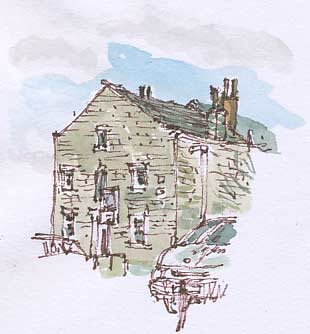
End of terrace on the junction of New Street and Prospect Road, Ossett, drawn during a coffee break at Cafe Vie.
 I WAS SURPRISED to see the first red Hawthorn berries this week, just odd ones, not a whole bunch as in my drawing. Most haws are still green but a few have ripened on a south-facing bush on the top of an
  embankment overhanging a pavement, so they’d had more warmth than most. I’ve also tasted my first Blackberry of the season and in the garden the autumn Raspberries in our garden.
 On the black railings of Addingford Steps there were dozens of ladybirds,
  so many in one place that I had the impression that they might have recently emerged from pupae, but perhaps it was the warmth of the metal that attracted them.
 There’s a patch of devastation on the marshy field known as The Strands between the river and the canal downstream from Horbury Bridge. My vague memories of this area of willows is that it started as a few willows next to a water-filled hollow and over the years grew to become a dense circular thicket. It has evidently taken a great deal of effort to clear it.