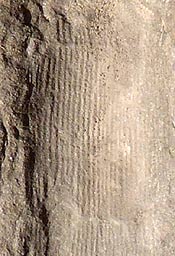
AS WE WALKED up to the moor at the top end of Langsett Reservoir I spotted this fossil of Calamites in the sandstone slab of the footpath.
Calamites was a the giant horsetail of the Carboniferous Period, 300 million years ago. Whorls of narrow leaves grew from each joint in the stem. In the close up you can see what appears to be a joint at the top of the picture.
Along with giant club-mosses, the horsetails of the lush tropical forests of the Carboniferous were fossilised to form coal seams. In West Yorkshire we still derive most of our electricity from coal-fired power stations so this entry in my online nature diary has, most likely, been powered in part by solar energy stored by these giant horsetails 300 million years ago.
IN THE conifer plantation at Langsett slime fungus is on the move. About two inches long and as bright as a plastic lemon, it is making its way imperceptably up onto a stone at the edge of the track. They’re normally found amongst decaying plant material, rather the creeping along the footpath beside you.
You can see the trail of slime it has left behind, as it moves along cosuming algae, bacteria and fungi. This free-roaming blob of protoplasm, known as the plasmodium, has multiple nucleuses.
Plant or animal? A bit of both perhaps. The Slime Fungi are grouped in the phylum of Myxomycetes, in the kingdom of Protists, which also includes the algae and protozoa. The Protists are considered to be intermediate between animals and plants but possibly not related to either.
OUR JOURNEY home, first by rail; from Wengen via Lauterbrunnen, Interlaken Ost and Spiez to Zurich Airport.
I see a Dipper fly up river where we’d seen them, nesting in a stone embankment wall, on our walk from Zweilütschinen to Lauterbrunnen on Saturday. The morning sun gives Lake Thun and its surroundings the heightened colour and crispness of a travel brochure as our journey takes us parallel to its shore. We see Red Kites circling and the occasional Buzzard between each tunnel we dip into.
Zurich Airport
Our last Swiss Francs, (our very last, they let us off the small change!) are spent on two mugs of tea at the Marché self-service restaurant at Gate 43, Zurich Airport. You select your fresh vegetables (and they really do look fresh), and meat or fish if you wish, and they’re prepared for you as you wait. There’s stir-fry on one side and oriental soup, also prepared as you wait, on the other.
We’re going to have to come back with a larger supply of Swiss francs if we want to sample the results . . . unless Marché can be persuaded to open one or two of their restaurants in England.
I’m sketching as we go over Switzerland (adding the colour later) and over the fields of France but I’m disappointed to look down on featureless cloud as we approach the Channel.
At 2.30 pm this breaks up into a flock of fleecy clouds and as we reach the coast, then there’s a break, probably because there are no thermals of rising air over the sea.
Over the White Cliffs of Dover
I sketch quickly because I guess that my brief glimpse of the French shoreline might be recognisable from a map; to the east of the plane I see two coastal towns on a promontary then soon, after passing over open water with lanes of shipping, we come to a coast with white cliffs. Not being able to see the view to the west, I’m unable to tell whether this narrow strip of water is an inlet, such as the bay of Mount Saint Michel in Normandy, or the Channel itself.
Looking at the atlas when we get home, I can see that the two French seaside towns must be Wissant and the nearby towns of Audresselles and Ambleteuse so the chalk cliffs are, obviously, the white cliffs of Dover.
We pass over an inlet with salt-marshes, which must be the Thames estuary, then the fields of the Midlands which have a less regular pattern than those of central France.
As we descend into the grey cloud and rain of Manchester, I realise that we’re crossing the Peak District. There’s no chance of spotting Langsett Reservoir, our regular Peak Park escape, but a small gap in the cloud reveals the three ‘Dambusters’ reservoirs of Howden, Derwent and Ladybower.
If this kind of weather continues, there shouldn’t be the slightest problem in keeping these three mighty reservoirs topped up!
DREW THE bluest of the gentians on Männlichen, the Spring Gentian, Gentiana verna, then set out again on the Panoramaweg in what we thought would be a brief shower but which turned into rain. We dried out by stopping at a mountain restaurant for soup and a roll.
1.30 pm, Kleine Scheidegg station.
The Alpine Choughs have very dark eyes, which don’t show up at any distance like those of our Jackdaw. Perhaps the dark pigment in the eye acts as a U.V. Filter.
2 then 3 or 4 choughs descend on plates of noodles and spaghetti as soon as they are left, casting plastic forks and paper serviettes aside before throwing the paper plate itself onto the ground.
We take the train down to Grindelwald Grund then return back up via the gondola to Männlichen. We can’t resist fitting in our marmot-spotting journey just one more time.
A buzzard circles in a clearing amongst the tall conifers, giving us a view from below, then on level with (we can see the details of its eye and cere) and finally from above. As we glide past in our gondola it’s like being in a wildlife documentary where they film at treetop level from a microlight.
Some of the conifers are the height of our electricity pylons and in proportion as long and thin as slender pencils. Very long slender pencils. Some have bunches of long purple cones, similar to the weights on traditional cuckoo-clocks.
We spot only one marmot, sitting like a sphinx, looking uphill but as a final bonus a red kite gives us a fly-past just as we near the upper station. Like the buzzard it gives us a perfect, unhurried diagnostic view, enabling us to see the shallow ‘V’ of its wings as it glides towards us, then the markings as it dips below us.
No Chamois today but flock of Alpine Choughs dip down to the cable car, as if in a farewell salute, then fly off over the crags.
6.30 pm, After all the travelling around, looking at wonderful scenery during this wonderful two week holiday, I realise that I would have been equally happy to have been fixed in one spot, taking a close look at the birds, butterflies, flowers and fossils. Perhaps next time I should go to a small island!
I draw these wild flowers in the meadow by the children’s play area in Wengen. It’s on an embankment with a retaining wall, so I don’t even need to bend down to draw them. My varifocal spectacles are perfect for this kind of work with flowers and my sketchbook both comfortably in their focus zones. I find myself using a fine no.1 tipped Pilot Drawing Pen and adding small-print notes to my drawing, as I did 30 years ago when compiling my Richard Bell’s Britain sketchbook.
The flower on the left is a bellflower, Campanula rhomboidalis, which is found in the Alps and the Jura up to 2200m in meadows and on grassy banks.
On the right is a species of scabious, either small or shining, S. columbaria or S. lucida.
The Spiked Rampion, in the middle, is a member of the bellflower family but it lacks the showy bells of its relative. Instead it has this plume-like flowerhead.
CLOUDY THIS morning and from the gondola down from Männlichen we spotted only one marmot by its burrow.
When we arrived at Grindelwald we found that the Tour Suisse had arrived and the small town had taken on a festival atmosphere. We decided to leave the bustle behind us and we took the next train to Interlaken Ost, then decided to get off at Wilderswil to walk alongside the river to Bönigen on Lake Brienz.
12.55 pm, Lake Brienz, or Brienzersee, from the ferry landing stage at Bönigen. Compared with Lake Windermere, England’s largest lake, the water is turquoise with the surrounding hills rising to about three times the height.
Drawing this view reminded me of the song Bali Hai sung by Jaunita Hall in her role as Bloody Mary in the musical South Pacific – a film that I saw only once, one torrentially wet day in Ayr in 1959, when the windscreen wipers of our Standard Vanguard estate broke, being unable to cope with the force of the deluge on our Scottish summer holiday. I’m surprised to see on Google-Street that the cinema – a rather forbidding-looking grey blockhouse of an Odeon on its ‘own special island’ – still stands in the middle of town and the garage where I remember us stopping half a century ago is still there, now a filling station.
The craggy island in the film is shown in glorious Technicolor ‘floating in the sunshine, [its]head sticking out from a low-flying cloud’.
I also remember a large hotel in Ayr where we sat drying out with a tray of tea by a fireplace decorated with tiles depicting the Greek myths. I kept pestering my mum to tell us the story behind them, such as the one of Hippomenes who threw down three golden apples to distract the huntress Atalanta in a race.
Wonder if the hotel too has survived and if so whether the wonderful fireplace survived the era of ‘modernisation’ in the 1960s and 1970s.
I’d be about 8 years old at the time and I’d already taken drawing books on previous holidays but that Scottish holiday was the first on which I remember trying to write and illustrate a holiday journal. I went for a magazine format, folding up some reject offset paper my dad had brought back from work (disadvantage; it had the yellow separation of a colour photograph of a woman in fur coat printed on it at regular intervals). My cover drawing was of a Scotsman in a kilt, carrying his bagpipes through a glen and stopping to smile at a sheep. The back cover featured the Edinburgh Castle Tatoo but I think that was about as far as I got with it and unfortunately I lost it long ago.
2.45 pm, Japanese Garden, Interlaken
Snowfinches
4.30 pm, on the return journey we see four marmots in what I’ve come to think of as the lower colony near the stream but none in the upper colony near the gondola station.
We get good views of a couple of Snow Finches, looking down on them as our gondola approaches the upper station. Appropriately one of the finches lands on a patch of snow and starts pecking about. The book says ‘often seen foraging at ski-resort restaurants’.
Until I looked up this bird in the book when I got home, I’d assumed that these were Snow Buntings, which I’ve seen in the Cairngorms and Iceland but in the Alps they’re replaced by this similar but not very closely related species.
I SPENT the morning recovering from a 24 hour tummy bug. Perhaps I shouldn’t have gone for the sausage and rosti on Friday! But also a feeling of exhaustion, as I guess we’ve been trying to do too much.
We sat and watched the world go by from a bench on the small grassy triangle by Wengen station. The coming and going of trains and of the tourists and the sublime view up the Lauterbrunnen Valley provided the right combination of distraction and restfulness for me.
In the afternoon we took the cable car up to Männlichen. I wasn’t up to drawing today so as we took the Panoramaweg – a footpath that runs more or less on the 2200 m contour around the summit of Tschuggen – Barbara took over the camera and photographed the Alpine flowers along the trail, for example this saxifrage. The name comes from the Latin, saxum frango, meaning ‘stone breaker’.
The battery in our camera ran out after a week but we’ve got it fully recharged now, thanks to the photo-shop in Wengen. And, thanks to our gentle walk along the Panoramaweg, I’m feeling recharged too.
THERE’S AN inscription carved on a cornerstone dated 1682 but the notice (in German) appears to suggest that the structure, a ‘Schmelzofen’ (smelting furnace) may date from 1650 but the date 1715 is also mentioned, possibly referring to a rebuilding. The structure stands on the east bank of the river between Zweilutschinen and Lauterbrunnen.
There’s no trace of burning in the arched openings on the north-west and south-west sides but there is a crust of what appears to be lime around the base of the bee-hive-shaped central chimney.
The inscription on the cornerstone on the north-west side of the furnace.
It had started to rain but I was able to draw sitting at a picnic bench beneath a sheet-plastic awning. A large woodsman’s axe had been left by a covered pile of logs, kept under cover for use on a large barbecue. You wouldn’t leave one of those lying around in England!
Sound of whistling – repeated 2-note phrases – as we passed over the marmot burrows. These two appeared to be keeping watch on some walkers 100 yards away.
Seen from above the marmot has a tail as thick as a German sausage – thicker in fact – with a black tip.
A stand-off – who will come out on top? –
A pair of Ravens or the mighty marmots – Europe’s largest member of the squirrel family?
No contest; one Raven pecks the tail of one of the marmots, which scampers off and stands right next to its bolt hole. The other marmot likewise stands beside a hole while the Ravens continue to strut along as the cocks of the walk.
Some of the marmot holes are enormous – perhaps where multiple tunnels have collapsed into each other.
Romantiweg
Pipit, Alpiglen
The Wengen-Männlichen gondola was back in operation again yesterday after repairs to the supporting cable following a lightning strike so this morning we were on it at about 9, up in the high Alpine grasslands about ten minutes later and before 10 we’d made our way to a little knoll on the north end of the Männlichen ridge that gives views of all the places in the vicinity that we’ve visited – Interlaken, the Alpine Garden at Schynige Platte, Grindelwald, and the Lauterbrunnen Valley, although this morning cloud blotted out the Jungfrau.
Drogerie, Grindelwald station
After coffee at the restaurant we followed the Romantiweg – the Romantic Footpath – across the slopes down to Alpiglen, making slow progress as there were so many different species of wild flower to stop and try to identify.
Chamois
On our return descent to Männlichen, in a cable car filled to capacity, we were able to position ourselves on the north side of the cabin so that we could see the area that the Chamois Trail footpath goes through on a steep upper slope where narrow meadows streak down between phalanxes of conifers. We were in luck; we saw our first Chamois. Well, actually I’d just decided that it was an odd-shaped sandy grey boulder lying by the path when Barbara spotted another 10 yards away from it, making its way along the path into the forest. We could make out the general shape through binoculars but not whether it had horns.
My close up of the Chamois (right) was of a stuffed specimen in a glass case in the lower cable car station. It was larger than I imagined; the size of a goat.
A day or two later we got a better view of a single Chamois, spotted by a sharp-eyed Australian as we waited for the cable car to descend. It was standing at the foot of the grassy gulley/clearing that runs below the cables. That one definitely had horns.
Mist over Männlichen
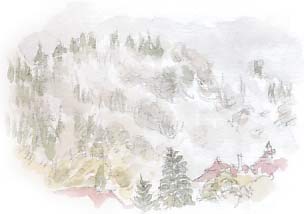
6.30 pm; These lower pinnacles of Männlichen were soon completely swathed in cloud when I started adding the watercolour to this little sketch made from our balcony. It’s now raining heavily (rather than torrentially) but it’s also brightened; there’s an overall yellowish hue to the meadows and chalets of Wengen, below the increasingly misty mountain above. The light is similar to the yellow band in a rainbow.
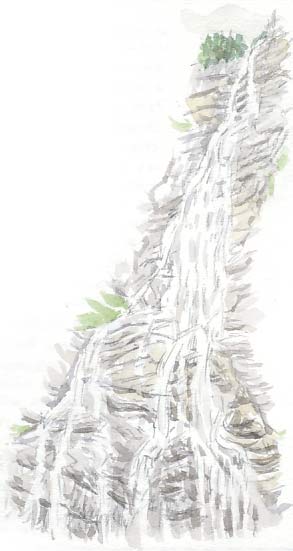
Mürrenbach waterfall, drawn from the kiosk cafe at Stechelberg at the top end of the Lauterbrunnen Valley
WITH CLOUD swirling over the upper slopes we make our way down to Lauterbrunnen. We’re surprised to find hoof-prints, and fresh cow-dung, on the winding path through the woods – surely they don’t take the cows up and down this path for milking every day!
Talking to Barbara (another Barbara) who serves us coffee at the Jungfrau Hotel, we learn that today is the day that the Lauterbrunnen Valley cattle are taken to the upper pastures on the Wengen side of the valley. On the Mürren side they were taken up a week earlier. This proved premature as an usually late snowfall meant that they found themselves up there in the snow.
Looking at my drawing of the Altetsch Glacier, Barbara tells us that she runs in the Aletsch half marathon which involves 21 kilometres along the lateral moraine of the glacier at over 1000m altitude.
Sand martins, house martins and swifts swoop low over the river.
Folk Evening at Wengen
Wengen Bell Ringers parade along the main street with their enormous cow bells, creating a rhythmic racket. As we’re in the mountains their procession reminded me of the ceremonies that Tibetan Buddhist monks perform to frighten off evil spirits.
The Alpine horn also resembles and instrument played by Buddhist monks but in Switzerland to mellow, rather than other-worldly, effect. The Buchel horn resembles a curled up Alpine horn. The soloist performed a piece called ‘The Guy from Mūrren’ which a friend had composed for him.
The Wengen and Mūrren Yodel singers didn’t go for the sort of yodelling that would echo across the valley; their songs were rather gentle and harmonically complex, about homely, Swiss country life, such as ‘The Saturday Evening Meal’.
The event, the first of a series this summer, was held in a large marquee by the tennis courts.
The band finished with a Dixieland jazz piece and the evening finished with dancing to an accordian trio.
Lace-makers and spinners demonstrated their crafts and there was a chance to sample local food and drink.
View from our balcony at the Hotel Bernerhof, 1.50 pm
OUR ONLY day of the holiday without a travel pass, so, on this drizzly morning, we walk up to the Park Hotel to follow Wengen’s Forest Trail on the lower western slopes of Männlichen. You can get a trail leaflet from the Tourist Information Centre in Wengen.
It’s an easy way to get familiar with the trees and flowers of the area as 69 species are labelled with their botanical names and in German, French, English and Italian (we’re only 22 miles from the border with Italy, but that’s over the mountains and across the Rhone Valley). Hornbeam, Carpinus betulus, for example, is Charme in French, Carpino in Italian and Weissbuche or Hagebuche in German.
2.15 pm
Rhododendron hirsutum is the German Behaarte Alpenrose, French Rhododendron cilie and Rhododendron peloso in Italian. The label suggests Hirsute rhododendron as the English name but I’d go simply for Alpenrose, which is also the name of one of the hotels in Wengen, one that has been attracting guests for over a century. In winter, one visitor tells us, you can ski right down to this hotel from the slopes.

 AS WE WALKED up to the moor at the top end of Langsett Reservoir I spotted this fossil of Calamites in the sandstone slab of the footpath.


 Folk Evening at