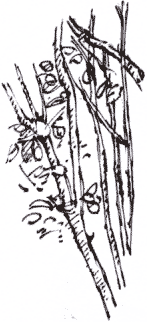
Fiver in the film, copyright Watership Down Productions, 1978.
I’VE WRITTEN before about my time working in the background department on the film version of Watership Down (see 5 November 2002) and included some roughs but here’s some of the actual artwork, which I’ve just found while going through the drawers of my plan chest. It’s drawn with a fine dip pen nib, a Gillot 303 or 1950, in Pelikan Special Brown Indian ink. This technique didn’t lend itself to the production size so I drew it half size and they photographed and printed a full-sized, sepia-toned version on matt paper.
The original drawing is about 5½ x 4 inches. It was an odd experience to see my postcard-sized drawing projected on the cinema screen – along with the animation, the music and the vocal talents of John Hurt and Richard Briers amongst others in that particular scene.
Another background artist added the colour later. No wonder I’m described as ‘Assistant Background Artist’ on the credits. As I’d explained when I took on the job, after working through the autumn on the film in London, I wanted to get back to Yorkshire by springtime to complete work on my first book, A Sketchbook of the Natural History of the Country Round Wakefield.
Like Cowslip’s Warren, this sketchbook format nature guide was drawn in brown ink using a fine-nibbed dip pen and printed – single colour – in the Pantone equivalent of Special Brown.
After working in my studio all day, I felt the need to draw some natural history; Blue Tits and Long-tailed Tits were the last visitors to the bird-feeders.
I’VE BEEN filling the drawers of my new plan chest today, half of them filled with artwork going back to my college days, so it’s full of memories. I’m filling the top drawers with art materials, sketchbooks and drawing boards so that I’ll never have an excuse not to get started on fresh artwork. Just open the drawers and I’ll have everything that I need.
So after my bird sketches from today here’s a brief dip in the bottom drawer, going back to my days at Batley School of Art, round about the autumn of 1967 when I was 16.
Signs of the Times
I can see the influence of some of the graphics styles of the day – as seen in the pages of the glossy international journal of graphic design of the day, Graphis. There’s also more than a nod towards Bernard Buffet, the popular French artist, who I’d briefly come across in Look & Learn, the children’s educational magazine.
The wobbly detail and fine pen in this black and white version of the same subject are more recognisably in my style. Technical pens were beyond the budget of most foundation students so I used ruling pen for this drawing. Road signs were responding to the changes in graphic design of the 60s with more readable sans serif fonts in upper and lower case replacing block capitals and symbols replacing the longer written instructions – such as ‘NO THROUGH ROAD FOR MOTOR VEHICLES’.
I like this illustration which is based on a sketch made in our kitchen at home. One of the pleasures of art school was the luxury of a session once a week to work when you had time to work up a rather messy and probably badly drawn sketch into something that looked presentable. For a number of my classmates, graphics was a favourite subject.
The class was taken by Colin West, our graphic design tutor who had recently qualified at Leeds. I went on to take graphic design at Leeds and I think that the opportunity to draw was one of the deciding factors.
The fine art department at Leeds had a growing reputation at the time for ‘happenings’, performance and whacky surrealist sculpture, the first stirrings of conceptual art perhaps, but I realised that I wouldn’t have got much encouragement to draw if I’d opted to go there.
Photograph of the back of one of the leaves seen through the microscope.
TURNING OVER a new leaf, as a change from the chairs, hands or architectural details that I normally draw when I’m in a waiting room, I pick up these dried leaves as we walk into Orchard Croft health centre in Horbury this morning.
It’s drawn with my new Art Pen and the Noodler’s brown ink flows just fine. Could this supplant my ArtPen filled with black as my favourite pen? It’s lovely to write with.
As the nib is a size up from what I’m used to, fine rather than extra-fine, the line tends to be bigger and bolder, which is no bad thing, I just need to approach drawing in a bolder and more confident way. No tentative whiffling movements! (whiffle meaning a slight movement, as if blown by a puff of air. In last week’s BBC TV bird spectacular EarthFlight, the word was used to describe the twist geese often give as they land, letting air out from under their wings by tipping over at an angle of 45 degrees).
I realised that in order to identify the species I was going to have to unfurl the dried up leaf. I had thought that it was the leaf of a species of Prunus, an ornamental cherry growing by the car park but there’s hardly anything in the way of teeth along the edge of the leaf, just a suggestion of it on the right margin of the larger apical leaf. There’s no suggestion that the smaller leave ever have a pointed tip, as cherry leaves do, although the damaged larger leaf might once have had a tip.
The buds in the axils of the leaves are reddish and pointed, resembling an apple pip. There are downy hairs on the back of the leaf, visible with a hand lens or through the microscope (top).
Despite all those white downy hairs this isn’t the leaves of Whitebeam; they aren’t broad enough. Some kind of willow perhaps, such as Goat Willow (but there are no auricles at the base of the leaves).
This is the problem with trying to identify a tree from the leaves only; you don’t have twigs, bark and fruits to give you extra clues. Still, more interesting than drawing the chairs in the waiting room again!
4.20 pm; THIS RUGGED polypropylene ‘Anywhere’ bird-bath, which we bought at the RSPB visitor centre at Fairburn Ings yesterday, is designed to go ‘Anywhere’ as its name suggests; hanging from the bird-feeder, fixed around the pole or staked to the ground with the plastic stake supplied, however we wanted to put it up on the patio, so we’ve just propped it up on bricks.
As I draw it, it’s freezing over, in fact thin ice has been forming all day, but a kettle of hot water should melt that away in the morning. So far it hasn’t attracted any of the birds that have been busy at the feeders right next to it all day.
4.03 pm: As sunset approaches (in about 15 minutes; the days are getting noticeably longer), a Heron flies across the meadow, away from the stream and the wood.
IT’S A PERFECT crisply frosty morning and we get out early enough to enjoy the sparkle of the low morning sun on the hoar frost at Fairburn Ings RSPB reserve. I’m pleased to see that they’ve tried building a Sand Martin wall (on the far right in my panorama above) on the south-facing side of the lagoon in front of the Pickup Hide as this is a form of nest box which was invented by local naturalist Charles Waterton, who set up a sand martin wall in the kitchen garden at Walton Hall over 150 years ago.
The original wall was dug out by a JCB, presumably to the recycle the stone, about 30 years ago by the farmer (who used to tell me that he was a Waterton fan!). Brian Edgington, who was writing his Waterton biography at the time happened to turn up on the day of the demolition and had to watch helplessly as this cornerstone of conservation was destroyed.
But look, you can build one again, it’s easy. Waterton would have approved and I think that he’d concede that the RSPB have sited it more appropriately than his, which was abandoned by the martins after a few years. A few Starlings were nesting in it when I photographed it (probably the only photographic record we have of it) in the 1970s.
It’s such a pleasure to walk around the reserve which has been transformed by the frost and snow.
It’s good to see dozens of Tree Sparrows at the bird-feeding stations.
They’re joined by other species, notably Goldfinches, which, thanks to the simple fence with slots cut into it, I’m able to attempt to photograph with my little Olympus Tough, a camera that was never designed for this kind of subject.
It might be a bit limited but that wasn’t going to stop me having a go at capturing the aggressive behaviour of these Coots on one of the frozen ponds. The body language of the pair on the right was quite enough to send the single bird scurrying away. Despite the magical backdrop, you couldn’t describe Coot choreography as Swan Lake on Ice.
By the way, this photograph had to be stitched together from two taken in quick succession. With a delay of what seems like a whole second, but probably isn’t, the Tough can’t instantly catch fast-paced action of Coots.
We make our way across what I remember a decade or two as grey open colliery spoil heap, later an open space with thousands of newly planted ‘whips’ of trees. It’s now grown into mixed woodland, although one of the volunteer wardens tells us that it isn’t yet mature enough to attract Nuthatches, although they do see Treecreepers.
We continue on this path to take a look at the main lake, which isn’t frozen over like the smaller pools. I sketch a greyish/brownish duck. It has the shape of a Goldeneye but I decide to check it out by making a field sketch (colour added later).
Checking it out with the bird guide at home the key feature that identifies this bird as a female rather than a juvenile or a drake in eclipse, is the white ring around its neck. But I also noted that it has light-coloured eyes, and the book points out that the juvenile has darker eyes.
That was the limit of my drawing on this cold day. We decided not to take a flask of coffee to drink in the hide (which with no door and no window flaps is a rather chilly one today) and instead we headed back for a Fair Trade coffee from the machine in the Visitor Centre with a view of the bird feeders.
Barbara put together a do-it-yourself bird-feeder log, stuffing the larger holes drilled in it with fat-ball mix and the smaller ones with peanuts.
Here’s one last photograph; the view from the side window of the Bob Dickens hide by the main lake.
3.30 pm; THREE Long-tailed Tits join the Goldfinches, House Sparrows, Bullfinch, Greenfinch, Chaffinch, Great Tit and Blue Tit already at or around the bird feeders. While most of the other birds are going for the sunflower hearts in the feeders or spilt below, the Long-tails go for the fat-balls.
A Wood Pigeon lands on the ivy in front of our next-door neighbour's. The ivy berries, now ripe, are probably the attraction.
Great Tits, Blue Tits and sparrows will also go for the fat-balls but we don’t recall seeing any of the finches feeding on them.
We’ve given up on putting out peanuts. They get left whenever sunflower hearts are available and they soon go soft.
The downside to this is that peanuts – especially red bags of peanuts – are particularly attractive to Siskins and, so far, we haven’t seen this small finch at the feeders this winter.
New Sketchbook
So far I’ve been saving my lime green A5 landscape format Pink Pig sketchbook for natural history subjects; I managed to draw 14 pages last year between mid-May and the beginning of August before events took over and I had to be content with a few snatched moments of natural history in my regular sketchbook.
That regular sketchbook, a black A5 portrait format sketchbook with soft, bleed-through cartridge paper that I’ve never cared for, is now complete and the drawing of the lime green sketchbook (above) is the last that I’ve got room for.
I’m now going to use the green for my everyday sketches but, of course, I’m hoping that on most days that will involve natural history.
Chimney drawn from the optician's waiting room last month.
The little black book contains so many waiting room sketches – I take my mum to about 50 appointments through the year, and then there’s our regular visits to dentists etc on top of that – so the lesson that I can learn is always to carry some ‘natural form’ object with me, for those inevitable unplanned periods where I have to wait a little longer than expected; a pebble, a leaf, a fossil or a feather for instance.
The most popular waiting room subjects in the little black book were architectural details (11), chairs (7), hands (4), trees seen through the window (3), piles of magazines (2) and my shoe and the reception desk at the doctors (1 of each). There are also three sets of sketches of the goldfish in the dentist’s.
Café Rouge
Here are the last couple of sketches drawn on location in the black book this lunch time at Café Rouge in Meadowhall between my first one-to-one session learning a bit more about my new computer at the Apple store and heading off to Orgreave with a consignment for our book suppliers.
You might be thinking whatever happened to our ideal of getting back to healthy eating, well, apparently the grilled chicken with roast vegetables and bulgar wheat amounts to just 600 calories.
How many calories the chocolate and banana crepe contained we didn’t trouble ourselves to find out.
IT SEEMS so long since we had such a bright day. It’s as if someone has turned up the colour saturation across the landscape. It’s so clear and breezy that distant buildings and wind turbines on the tops of the moors add a sparkle to the panorama of West Yorkshire’s old Heavy Woollen District, as seen from Charlotte’s ice cream parlour up on the ridge at Whitley.
Two ArtPens
The Rotring ArtPen with the fine sketch nib that I drew my brown shoe with this morning is my current favourite. The Noodler’s black ink in it’s fountain pen filler flows smoothly.
My identical ArtPen filled with Noodler’s El Lawrence brown ink by comparison doesn’t flow as consistently. It does’t give me a feeling of inky reliability as sometimes it doesn’t seem to be flowing enough while at other times it will produce a sudden blot.
I have to admit that when it blotted I was holding the pen upside down at a shallow angle to get into a small detail of the roof that I couldn’t seem to reach comfortably – or see properly – with my hand in the normal position below.
WITH MY STUDIO taking shape, I feel that I’m beginning to get back my enthusiasm for drawing. I hadn’t lost it really, I’d just found myself beset with other tasks. This morning in the dentist’s, as I didn’t have a direct view of my usual subject, the fish tank, I took the opportunity to draw the chairs. Usually I have time to draw only one chair but today I had the chance to add more. There’s something fascinating about the way one chair places itself in front of another to give a broken rhythm of verticals and horizontals. Considering that they’re such regular shapes, these utilitarian chairs produce odd jigsaw-piece shapes in the empty spaces seen between them.
I might not be diving headlong into a project, as I have been after Christmas during the past three years, when I rushed to get my Rhubarb, Robin Hood and Ossett walks booklets into print to launch at the annual Rhubarb Festival but I feel that I’m creating the possibility of finding more unusually shaped spaces (for drawing) between the rigid and repetitive elements of my life.
The rhythmic repetition and variation in the simplified version of the drawing remind me of the structure of a piece of music. Those little hatching marks, representing the varying weave of alternate carpet tiles are like the minor variations that you’d have within the larger blocks that shape a musical composition.
Simplifying the design to flat colours gives a retro feel, like Penguin paperback covers of the 1950s and 60s so, with some lettering added, I could see this as an album cover for some rather laid-back music inspired by the jazz of that era. Some of those shapes remind me of the floating shapes in Miro paintings or the stylised backgrounds of a 1950s cartoon . . .
This could be cityscape perhaps. Or perhaps I’d better stop messing about with Photoshop!
Because of a hitch with the equipment, I had to return to the dentist's in the afternoon and this time I had a seat by the goldfish tank.
AT THIS EVENING’S 139th annual general meeting of the Wakefield Naturalists’ Society (we’ve been going since 1851 but we obviously missed a few AGMs along the way) there are records of wintering wildfowl, such as the Great Northern Diver at Pugneys, but also unseasonal appearances of insects with a couple of wasps being seen today in one garden and a Red Admiral elsewhere. Things were different last year during a long cold spell.
IT’S TOO WET and windy for us to continue up onto the moors after our stop for a flask of coffee on the bench overlooking the River Little Don upstream from Langsett Reservoir so we take the shorter route back to the car park through the plantations. Some of the tall – but shallow-rooted – conifers have recently been blown down.
There’s a flock of between one and two hundred Redwings in one of the pastures sheltered by the top edge of the wood. Amongst them what appears to be a bird with a much paler version of the plumage. I think the term would be leucistic, which means lacking in pigment – the word comes from the Greek leukos meaning white. This one I would describe as a pale biscuit colour.
My sketch is of a normal Redwing from the earlier years of this diary, which explains its dotty quality as in those days I always scanned at 72 rather than 100 dpi and this is a GIF, a compressed image file that uses a limited range of colours. In those days of painfully slow dial-up connections, I could get away with this kind of image when it was viewed on the lower resolution monitors of that time.
A Nibbled Cone
I picked up this nibbled cone by the side of the track. I’m guessing that this is the work of a squirrel rather than a Crossbill, which we’ve seen here in the past. A Crossbill tends to tweak and twist the seeds from between the scales while a squirrel would eat it like a corn-on-the-cob, discarding the core.
We saw several Grey Squirrels on our walk through the woods, including two pairs. At this time of year the males are likely to be trailing around after the females or giving chase.


 TURNING OVER a new leaf, as a change from the chairs, hands or architectural details that I normally draw when I’m in a waiting room, I pick up these dried leaves as we walk into Orchard Croft health centre in Horbury this morning.