The Lime Green Sketchbook

3.30 pm; THREE Long-tailed Tits join the Goldfinches, House Sparrows, Bullfinch, Greenfinch, Chaffinch, Great Tit and Blue Tit already at or around the bird feeders. While most of the other birds are going for the sunflower hearts in the feeders or spilt below, the Long-tails go for the fat-balls.

A Wood Pigeon lands on the ivy in front of our next-door neighbour's. The ivy berries, now ripe, are probably the attraction.

Great Tits, Blue Tits and sparrows will also go for the fat-balls but we don’t recall seeing any of the finches feeding on them.

We’ve given up on putting out peanuts. They get left whenever sunflower hearts are available and they soon go soft.

The downside to this is that peanuts – especially red bags of peanuts – are particularly attractive to Siskins and, so far, we haven’t seen this small finch at the feeders this winter.

New Sketchbook

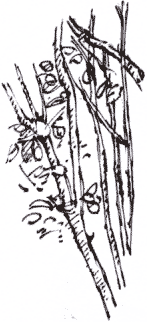
So far I’ve been saving my lime green A5 landscape format Pink Pig sketchbook for natural history subjects; I managed to draw 14 pages last year between mid-May and the beginning of August before events took over and I had to be content with a few snatched moments of natural history in my regular sketchbook.

That regular sketchbook, a black A5 portrait format sketchbook with soft, bleed-through cartridge paper that I’ve never cared for, is now complete and the drawing of the lime
green sketchbook (above) is the last that I’ve got room for.

I’m now going to use the green for my everyday sketches but, of course, I’m hoping that on most days that will involve natural history.

Chimney drawn from the optician's waiting room last month.

The little black book contains so many waiting room sketches – I take my mum to about 50 appointments through the year, and then there’s our regular visits to dentists etc on top of that – so the lesson that I can learn is always to carry some ‘natural form’ object with me, for those inevitable unplanned periods where I have to wait a little longer than expected; a pebble, a leaf, a fossil or a feather for instance.

The most popular waiting room subjects in the little black book were architectural details (11), chairs (7), hands (4), trees seen through the window (3), piles of magazines (2) and my shoe and the reception desk at the doctors (1 of each). There are also three sets of sketches of the goldfish in the dentist’s.

Café Rouge

Here are the last couple of sketches drawn on location in the black book this lunch time at Café Rouge in Meadowhall between my first one-to-one session learning a bit more about my new computer at the Apple store and heading off to Orgreave with a consignment for our book suppliers.

You might be thinking whatever happened to our ideal of getting back to healthy eating, well, apparently the grilled chicken with roast vegetables and bulgar wheat amounts to just 600 calories.

How many calories the chocolate and banana crepe contained we didn’t trouble ourselves to find out.


Bright Day

IT SEEMS so long since we had such a bright day. It’s as if someone has turned up the colour saturation across the landscape. It’s so clear and breezy that distant buildings and wind turbines on the tops of the moors add a sparkle to the panorama of West Yorkshire’s old Heavy Woollen District, as seen from Charlotte’s ice cream parlour up on the ridge at Whitley.

Two ArtPens

The Rotring ArtPen with the fine sketch nib that I drew my brown shoe with this morning is my current favourite. The Noodler’s black ink in it’s fountain pen filler flows smoothly.

My identical ArtPen filled with Noodler’s El Lawrence brown ink by comparison doesn’t flow as consistently. It does’t give me a feeling of inky reliability as sometimes it doesn’t seem to be flowing enough while at other times it will produce a sudden blot.

I have to admit that when it blotted I was holding the pen upside down at a shallow angle to get into a small detail of the roof that I couldn’t seem to reach comfortably  – or see properly – with my hand in the normal position below.

The Dentist’s Chairs

Negative shapes between the chairs.

WITH MY STUDIO taking shape, I feel that I’m beginning to get back my enthusiasm for drawing. I hadn’t lost it really, I’d just found myself beset with other tasks. This morning in the dentist’s, as I didn’t have a direct view of my usual subject, the fish tank, I took the opportunity to draw the chairs. Usually I have time to draw only one chair but today I had the chance to add more. There’s something fascinating about the way one chair places itself in front of another to give a broken rhythm of verticals and horizontals. Considering that they’re such regular shapes, these utilitarian chairs produce odd jigsaw-piece shapes in the empty spaces seen between them.

I might not be diving headlong into a project, as I have been after Christmas during the past three years, when I rushed to get my Rhubarb, Robin Hood and Ossett walks booklets into print to launch at the annual Rhubarb Festival but I feel that I’m creating the possibility of finding more unusually shaped spaces (for drawing) between the rigid and repetitive elements of my life.

The rhythmic repetition and variation in the simplified version of the drawing remind me of the structure of a piece of music. Those little hatching marks, representing the varying weave of alternate carpet tiles are like the minor variations that you’d have within the larger blocks that shape a musical composition.

Simplifying the design to flat colours gives a retro feel, like Penguin paperback covers of the 1950s and 60s so, with some lettering added, I could see this as an album cover for some rather laid-back music inspired by the jazz of that era. Some of those shapes remind me of the floating shapes in Miro paintings or the stylised backgrounds of a 1950s cartoon . . .

This could be cityscape perhaps. Or perhaps I’d better stop messing about with Photoshop!

Because of a hitch with the equipment, I had to return to the dentist's in the afternoon and this time I had a seat by the goldfish tank.

Wasps in Winter

AT THIS EVENING’S 139th annual general meeting of the Wakefield Naturalists’ Society (we’ve been going since 1851 but we obviously missed a few AGMs along the way) there are records of wintering wildfowl, such as the Great Northern Diver at Pugneys, but also unseasonal appearances of insects with a couple of wasps being seen today in one garden and a Red Admiral elsewhere. Things were different last year during a long cold spell.

The Edge of the Moor

IT’S TOO WET and windy for us to continue up onto the moors after our stop for a flask of coffee on the bench overlooking the River Little Don upstream from Langsett Reservoir so we take the shorter route back to the car park through the plantations. Some of the tall – but shallow-rooted – conifers have recently been blown down.

There’s a flock of between one and two hundred Redwings in one of the pastures sheltered by the top edge of the wood. Amongst them what appears to be a bird with a much paler version of the plumage. I think the term would be leucistic, which means lacking in pigment – the word comes from the Greek leukos meaning white. This one I would describe as a pale biscuit colour.

My sketch is of a normal Redwing from the earlier years of this diary, which explains its dotty quality as in those days I always scanned at 72 rather than 100 dpi and this is a GIF, a compressed image file that uses a limited range of colours. In those days of painfully slow dial-up connections, I could get away with this kind of image when it was viewed on the lower resolution monitors of that time.

A Nibbled Cone

I picked up this nibbled cone by the side of the track. I’m guessing that this is the work of a squirrel rather than a Crossbill, which we’ve seen here in the past. A Crossbill tends to tweak and twist the seeds from between the scales while a squirrel would eat it like a corn-on-the-cob, discarding the core.

We saw several Grey Squirrels on our walk through the woods, including two pairs. At this time of year the males are likely to be trailing around after the females or giving chase.

Hampered

Kestrel perched in the a tree in Coxley near a couple of Wood Pigeons; it was instantly distinguishable from them, even in at a distance, by its distinctive silhouette; a cross between a juggler's club and banana-shaped.

WE ENJOYED dipping into a couple of hampers that friends and family had bought us for Christmas and although it was a welcome treat to indulge in the selection of pork pies, patés and home-made chocolates, the result was that we ended up a few pounds over our target weight by the time the new year arrived. And we can’t just blame the hampers; we’d been slipping a bit in our healthy eating ever since our holiday in Switzerland last summer. Whatever the reason, new year seems like the right time to make a fresh start.

We’ve been going for food with fewer calories, for instance soups and a kind of rustic stew of seasonal vegetables made with a dash of Worcestershire Sauce but we’re also determined to get out a bit more and burn up a few calories in the process.

Hazel catkins had opened where the path from Thornhill comes down to Mill Bank lock on the canal.

Walking can burn somewhere between 100 and 175 calories per hours so on our 1 hour 40 minute walk to Thornhill Park and back this morning we burnt a good 150 calories or more – which I guess was about equivalent to the muesli etc that we ate for breakfast!

However, if we’d sat around all morning, we wouldn’t even have burnt off our breakfast.

Plan Chest


You can see why it was a bit of a wrench to part with my battered old oak plan chest. I guess that it's Edwardian. Back in the early 1980s, the woodworker teacher at Queen Elizabeth Grammar School in Wakefield was going to break it up for timber but when he heard that I was after a plan chest he arranged for me to buy it from the school. It was originally a third bigger with another two panels at the back on this end (an early form of plain plywood on the other) but it was too big to fit in my studio so I cut the whole thing down and rebuilt all 10 drawers.

I’VE BEEN treating the birch plywood carcass of my new plan chest/worktop with Osmo top oil. This oil and wax treatment is based on sunflower oil, soya bean oil and thistle oil with wax from the leaves of the Carnauba Palm, a native of Brazil, and from a spurge, Euphorbia sp., native to Mexico and Texas, known as the Candelilla or Wax Plant.

This non-toxic treatment worked so well on our beech-block kitchen worktops that I decided to go for the same finish in my studio. The two Ikea Alex range A2 drawer units that slot snugly inside the plywood frame are already finished in a white plasticised coatings of various sorts.

The whole unit is lighter in tone than my old oak plan chest and it fits a lot better into my long narrow studio space. The room is now less of a furniture repository and more a light, airy and, being less cluttered, a calm working space. I’m looking forward to a session of printing, folding, stapling and trimming copies of some of my black and white walks booklets, using my new work-top.

The £180 that I got fro my battered old plan chest paid for the two A3 drawer units that have replaced it. Even so I was sorry to see the old plan chest go, because it has been with me for a long time and I had put a lot of effort into restoring it.

Frank

“HAVE YOU noticed that whenever Frank’s around, we disappear?” says my brother Bill, as I focus on drawing Frank, the springer spaniel, who he’s holding on his lap.

Bill has already bowed to the inevitable and replaced his own photo with Frank’s on his Facebook page.

“At first I had a picture of Frank and me there but as all the comments were about him, I realised that people weren’t really bothered about me.”

I didn’t have time to draw Frank when I first met him before Christmas but I couldn’t resist taking quick photograph – cropping out my brother, of course!

At that time Frank has the rounded proportions of a younger puppy but three or four weeks later he’s grown considerably and changed in his proportions. He’s still got big feet – he is a spaniel after all – but his body has lengthened so that his head is no longer in the proportion to his body. At that time his proportions were closer to those of a cut cartoon dog character.

By the way, as my little before and after sketch suggests, Frank can do a quick change act; from one side, he’s liver and white, like a typical springer, from the other he’s plain white.

Lifting the Lid

AT SOME POINT during the night the wind blew the hinged plywood lid off the compost bins, luckily missing the greenhouse just feet away. Elsewhere in Yorkshire, lorries were overturned and trees brought down. On a positive note, the level in our leaky pond has risen slightly thanks to all the rain we’ve had.

According to weatherman Paul Hudson we’ve had rain on 34 of the past 35 days. Winds reached 93 mph at High Bradfield, South Yorkshire. Chimney pots have come down and one lean-to roof was blow right across the roof a house.

Spirit of the Woods

AFTER SPENDING several hours drawing the Nondescript in Wakefield Museum today, I feel that I’ve got more questions about it – or him – than I had before I started.

The naturalist Charles Waterton (1782-1865), who created this missing link to demonstrate his innovative method of taxidermy, wrote that the Nondescript or Itouli ‘has a placidity of countenance which shows that things went well for him in life’ but I feel that the creature is wistful rather than self-satisfied. There’s a suggestion that this zoological hoax may have been intended as a satirical portrait of the customs officer who had the temerity to charge import duty on a collection of tropical bird skins that Waterton was bringing into the country to display in his museum at Walton Hall near Wakefield. For me it goes a bit deeper than Spitting Image style satire; there’s a Sphinx-like enigma about him.

You might assume that as an ape-man, the Nondescript is Waterton’s riposte to Darwin’s theories on our origins but it dates from 1824/25, 35 years before the publication of The Origin of Species.

Waterton’s starting point for this creation was the skin of a Red Howler monkey which he collected on the last of his four Wanderings in South America in 1824.

The Nondescript is often seen as a joke that went wrong but I see him as a forerunner of characters (and hoaxes) such as King Kong, Piltdown Man and the Psammead in E Nesbit’s Five Children and It.

The Nondescript and the rest of the Waterton collection are currently not on public display because the Museum is in the process of moving to new premises in Wakefield One.