It was too windy to safely draw on the cliff top on our day trip to Flamborough on Tuesday, so these are puffins from our last month’s visit. A few were sitting together on a steep grassy slope in an inlet overlooking North Landing. When we visited on Tuesday there was just one, sitting tightly on a rocky ledge nearby.
A song thrush forages amongst the lush vegetation of the old railway embankment behind Books on the Lane, Walton, then flies down with a brown-lipped snail and thrashes it against the pebbles at the edge of the car park. Once it has extricated the mollusc it moves on to a fresh spot, whacks it again, eats a few morsels then flies off back up to the embankment, perhaps to feed its young.
You wouldn’t guess that it was midsummer from the way people are dressed in waterproofs, parkas and high vis jackets this afternoon on the windswept precinct behind the town hall in Ossett.
Figures drawn as I waited in the hairdressers. Watercolour added later from memory, but for most of the people I could remember that as the colour seemed as if it was a part of the character, as much as the way they walked.
Two useful pieces of advice from Agathe Haevermans’ Drawing and Painting the Seashore:
If you’re drawing a bivalve shell life size, start by drawing the outline around the shell
Position yourself so that the light is coming from the top left, throwing a shadow to the right and below the shell
The shape of the shadow helps explain the shape of the shell – whether it’s convex or concave
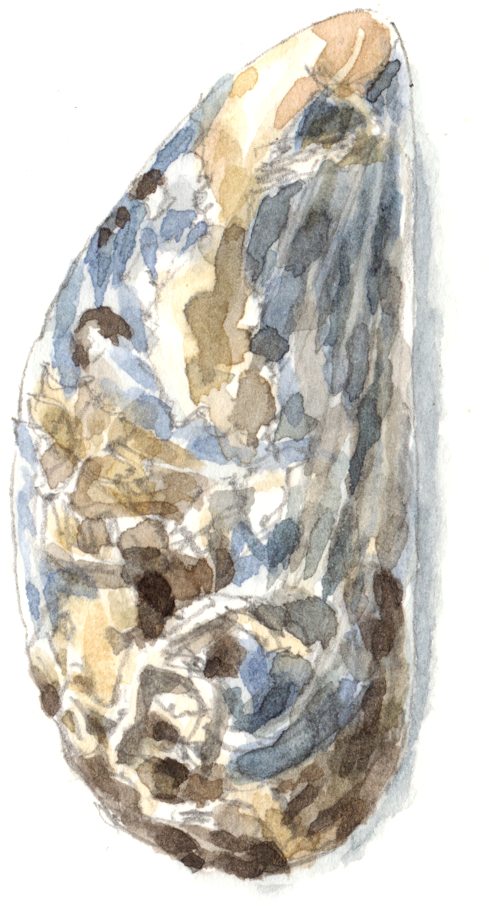
This mussel shell is encrusted with keel worm tubes. This is the left shell valve. The beak of the shell (top) is the anterior or front end from which the mussel’s foot emerges the its siphon emerges from the posterior end, at the bottom of my drawing.
We did a bit of beachcombing along the strandline at Bridlington yesterday, between award-winning North Beach Fish & Chips and a champion roast latte at the local Costa.
Most of the mussel shells were small single valves, broken off at the wider end, but a few remained complete and still connected, including this one, partly encrusted by barnacles.
It’s a good time of year to go back to Agathe Haevermans Drawing and Painting The Seashore. It’s rare for me not to start a drawing in pen and ink, but, going back to Havermans’ examples, which are so evocative of summer strolls along the strandline, I thought that I’d try out her techniques.
Catching up with our friend Diana is hot work this morning, sitting in her conservatory overlooking the back garden, in contrast to midsummer’s day when there were a few patches of frost in the Dales and our thermostat switched on the central heating for the first time in months.
Growing by the entrance lodge near the war memorial at Newmillerdam Country Park, green alkanet, a native of south-west Europe, was grown in cottage gardens. The name alkanet comes from the Arabic name or henna as the plant, especially the roots, can be boiled to produce a cherry red dye, used by the Victorians in lip balm.
My homemade card for Simon is my tribute to Gary Larson’s cartoon ‘The Holsteins visit the Grand Canyon’. Larson later wished he’d done a whole series and sent the family off to different locations, ‘such as Three Mile Island’.
I was tempted to replicate his gag of one of the Holstein calves ‘doing the old hoof-behind-the-head trick to its sibling’ but Larson concluded that this was just too subtle in the original and that most people (myself included) read it as one of the calves wearing a ribbon. Even knowing the artist’s intention, I still see it as one of the calves wearing a bow!
It’s 5 or 6 years since we last got to walk around Kew Gardens with our nephew Simon, so I hope we can join him again there before too long.
At this rate I’m going to spend more time working on my scale model than on the actual exhibit in Horbury’s Redbox Gallery, but it’s better to sort things out at this stage, rather than hope for the best when it comes to installing it.
I’ve thought about using recycled materials only, but there’s a slight risk that, although the box is watertight, if we had a spell of really wet weather, it might get humid in there, which would warp the corrugated cardboard that I had in mind. Graham, from the Civic Society who maintain the box, suggests thin marine ply, but that’s going to be difficult to cut out when I draw my cast of characters and scenery.
So, as illustrated in my scale model above, I think that the most practical solution would be white foam board, which is very light, dimensionally stable and much easier to cut. Half a dozen A1 boards would be as much as I’d need.
Making and Exhibition of Myself
Or there’s the conceptual approach.
‘Will you just stand in it and (try to) look interesting?’ asked my sister on Facebook.
Brilliant idea, here’s me practicing my ‘interesting’ look.
I always slip my Olympus Tough camera into my pocket when I set out to work in the garden and, even before I’d started repotting plants in the greenhouse, I noticed these zig-zag patterns on the seed tray I was using.
They look like the marks left by a snail scraping away a film of algae from the surface of the tray.
Probably one of the garden snails that I’ve evicted from the greenhouse on several occasions.