I FOUND this drawing pasted inside the front cover of a secondhand book. You wouldn’t have got that if you’d been downloading an e-book. It’s dated 8 May 1922, a Monday, and it’s apparently by a C A Clifford. The postman must have knocked on the door of this house on that Monday morning as Clifford records that he (possibly she?) received the book by post from publishers and that he paid 8 shillings and sixpence (42.5 pence but equivalent to about £9 in value today).
He left his mark on the book, stamping and writing his name and address in it seven times, in the front, back and middle. He gives his address as ‘Hoylandswaine, Nr. Penistone, Nr Sheffield’. I’d like to go there to see if I can identify the house (see below).
I can tell you a little more about Hoylandswaine as the book is Place-Names of South-West Yorkshire, by Armitage Goodall, M.A., late scholar of Queens’ College, published by the Cambridge University Press in 1914.
Place-names aren’t always what they seem, he tells us, for instance, you might guess that Armitage Bridge near Huddersfield gets its name from one of the author’s namesakes, the Armitage family who have long been associated with the area. In fact the family probably owe their name to the place; there was a Hermitage here. In a charter of 1212, the Normans refer to it as ‘Heremitagie que jacet juxta Caldwenedene brook’, the hermitage which lies beside the Caldwenedene brook’. The local people soon dropped the ‘h’ from this Old French word, and it appears as ‘ermitage’ in a deed of 1352.
Hoylandswaine was, he suggests, the Viking Sveinn’s piece of ‘high land’. It is recorded as Holande in the Domesday Book, which in the local dialect soon became Hoyland.
I find these place-names fascinating as I can often relate them to a landscape I know. It’s as if our Viking, Anglo-Saxon, Norman, Celtic and Roman predecessors are still there, evoked in the names we use every day.
Whistle and I’ll Come to You
This feeling of a historical presence in the landscape is a feature of M R James’s short stories, published as Ghost Stories of an Antiquary. In The Stalls of Barchester Cathedral the spirits dwell in ancient timbers, in Whistle and I’ll Come to You it’s a bone flute that triggers the supernatural events. One of my favourites involves a curious etching of an ancient house that alarmingly shows signs of life. In fact, can’t you see a face at the gable end window of The House at Hoylandswaine?! Those lace curtains were closed a moment ago . . . weren’t they?
It doesn’t surprise me that the leading member of the Editorial Committee of the Cambridge Archaeological and Ethnological Series, who published this Place-Names book, dealing as it does with a species of ‘ghost’ in the landscape, was M R James himself, Litt.D., F.B.A. and Provost of King’s College.
Cyril Clifford
My thanks to Elaine Graveston for identifying the house in the drawing and for the photographs and this information on the artist:
C.A. Clifford was the Headmaster of Hoylandswaine Primary School. I think his name was Cyril. His wife acted as an informal school nurse. The drawing is of his house, known as the School House and situated opposite the school itself. The school was built in the 1860s and served a small rural community and continues to do so. My father, his brother and sister along with the previous generation all attended the school and were taught by Mr Clifford.
The school is still thriving with about 90 pupils now and the subject of the picture is still unchanged. Although I live in Cambridge I happened to see the school and house only a few days ago when I was present at my aunt’s interment at the Parish Church which is situated only a short distance away.
You can see why the razor shells you find on sandy beaches get their name when you see old cut-throat razors like these; they have the same proportions and gentle curve. Abalone shell has been incorporated into the grapevine decorations on the handles of these razors. The abalone is ear-shaped with a row of perforations – which would be the effect one of these cut-throats would have on my ear, if I ever attempted to use it!
In Wild Yorkshire on 7 August I wrote about my great-great grandad, Samuel Bergin Swift who designed a cut-throat razor for Napoleon III.
It seems that his son George, my great-grandad on my mum’s side, might have been equally talented. I like to think my enthusiasm for applied arts – if I can include writing and illustrating books in that category – comes from that side of the family. Yesterday, while having a cup of coffee with my mum, we were talking about Samuel Bergin’s designs and she mentioned that she has two cut-throat razors that belonged to George.
They have the maker’s name on the blades; ‘JOSEPH RODGERS&SONS, CUTLERS TO THEIR MAJESTIES, No.6 NORFOLK STREET’; the firm where at least four generations of my family worked. The final line of the address, ‘SHEFFIELD’ is almost entirely worn away.
A collector who has a special interest in Rodgers’ pen-knives and razors tells me:
It’s very difficult to date Rodgers razors but they look to be late Victorian or Edwardian. The reference to THEIR MAJESTIES simply means the fact that Rodgers have been cutlers to George 4th, William 4th, Victoria and so on.
I have never seen decoration like that on a Rodgers razor before and so if you look, the pin at one end is different from the other end. My thinking is that these razors were either bought as standard razor blades and had different handles fitted. Or, the original handles got damaged and were taken off and replaced with these. This would not be unusual.
The very good news is that they have been replaced with some stunning inlaid pique work using possibly pieces of mother of pearl but the majority of it is definitely abalone. It is a much more iridescent and colourful shell than MOP. Your relative who worked at Rodgers would have likely been able to do this work easily or he would know someone who could. I think these handles are one of a kind. It doesn’t make them unique in particular, it just means they are a good example of pique work. Because pique work like this is all hand done, every item is different in some way. The grapes were a popular symbol of art nouveau decoration which makes me think these are late Victorian.
The decoration is superb. I forgot to mention that it looks like there is some inlaid metal in there as well. That would be perfectly normal. The metal and abalone compliment one another. It could be gold or silver, it’s difficult to say without seeing it.
The handles themselves look to be an early bakelite/plastic but it’s hard to say. They could also be buffalo horn, ebony wood or tortoiseshell. I didn’t think so at first but them I remembered that unpolished shell does have a very dark colour to it, especially when it’s thick. I’m sorry I cannot help you more in that handle material. One thing you could do is hold the handle up to a bright light and if i has a browny colour, it will be shell. Horn and ebony tend to have a grained appearance which I don’t think these have. If you cannot see a grain and it doesn’t shine brown through a bright light, I would think they are bakelite.
Because the handles are mounted on metal, I haven’t been able to shine a light through them. Along the edges, I can’t see any signs of them being translucent.
“From Rotherham we turned north west to Wentworth, on purpose to see the old seat of Tankersley and the park, where I saw the largest red deer that, I believe, are in this part of Europe: One of the hinds, I think, was larger than my horse, and he was not a very small pad of fourteen hands and half high. This was anciently the dwelling of the great Thomas Wentworth, Earl of Strafford, beheaded in King Charles the First’s time, by a law, ex post facto, voted afterward not to be drawn into a precedent. The body lies interred in Wentworth Church.”
Daniel Defoe, A tour thro’ the whole island of Great Britain, 1727
As you head north on the M1 from Sheffield to Wakefield you pass the Park, now a golf course, visited by Defoe in the 1720s. There had been 280 deer in the park in 1653 but by the late 1800s the Park had long been split up and the remaining deer were removed to Wentworth.
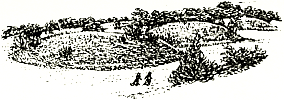
The mounds on the golf course are spoil from shallow pits dug to get at a layer of ironstone. Sparse, rabbit-nibbled grasses, yarrow, birdsfoot trefoil and other wildflowers cover each circular mound of shale but in the central depression, where the old shaft has caved in, thorn and elder bushes take root.
These ironworkings date from the 1790s, after the break-up of Tankersley Park, and by 1850 about 250 ironstone miners worked here.
Over one thousand Churchill Tanks were assembled here during World War II in a factory which stood on a site 500 yards west of the M1.
‘Many were slain and some taken prisoners’ when the Royalists won a victory over the Roundheads in the Battle of Tankersley Moor, 1643. Sir Francis Wortley, a Royalist who led a troop of some 900 men in the battle, had cannon balls made at his forge a nearby Wortley. Cannon balls and a bullet found on the battlefield are preserved in Tankersley Church, which stands on the hill overlooking the motorway.
Years ago, when I led a series of Calder Valley Walks as a further education class, these slopes between Ossett and Dewsbury were the western limits to our explorations. It wasn’t one of our regular routes and my memory of our occasional winter visits is of trying to locate an indistinct footpath that zigzagged aimlessly across a dark, muddy, misty, featureless ploughed field. I’m pleased to discover, coming back a decade later, that the wayward footpath has now been replaced by a new logical version which follows a ditch straight down the slope.
It’s amazing how much the landscape has changed since I was last here; the new footpath now leads to a plantation of poplars, planted with regimental precision, which have grown ten or fifteen feet tall since my last visit. I have memories of these as ‘whips’, freshly planted in plastic rabbit-guards. ‘It would be interesting to come back here, to see how it changes’, I suggested, looking at the newly landscaped slopes.
There’s new planting too on the banks of the Calder with an area of willows which I guess have been planted as bio-fuel. Old maps of the Calder valley show osier beds where willow was grown for basket making. The baskets were hand-made on an industrial scale by Burdekins, now located at Flushdyke near Spring Mill but today a furniture store. The bulk of their trade was for textile mills including large baskets for spindles of yarn and wheeled baskets for the rag recycling trade. Baskets for pigeons and pets were a sideline for them.
The name Runtlings may be Old English for ‘the meadow with the ditch’.
‘Ings’ can mean ‘meadow’, ‘hill’ or ‘place’. ‘Rene’ of ‘ryne’ is a ‘ditch’ or ‘channel’ and a ‘run’ is a ‘stream’. But I wonder if the name might derive from ‘hruna’; a tree trunk or log used as a conduit for water.
Drawings to follow! Please come back in a day or two . . .
St Mary’s Church, Gawthorpe, 102 years old this year, stood close to the western boundary of Ossett, between Chickenley Heath and Ossett Street Side. I drew it in 1999 shortly before the vicar, Rev. Paul Maybury, moved on to Holy Trinity, Ossett’s cathedral-sized parish church, which is 50 yards long with a spire, at 226 feet, almost rivalling that of Wakefield Cathedral, 3.5 miles to the east, which at 247 feet is the tallest in Yorkshire. Ossett’s spire tends to be more prominent when seen from the local countryside as the church stands at 357 feet above sea level – over 200 feet higher than Bichehill where the cathedral stands. St Mary’s never had a tower, just the belfry at its east end above the chancel arch.
It closed in 2002 and there were plans a couple of years ago to convert the building into luxury flats but the state of the housing market must have made that scheme impossible.
It was a shock to drive past today and see that demolition was in progress. I know that the spirit of a church lies in its congregation and the building is just the place they meet but it’s also a monument to the craftsmen who built it so I feel that it’s a shame that it has proved impossible to find an alternative use for building.
Gawthorpe St Mary’s Cricket Club, founded in 1928, still play at Slazenger’s Sports Club, Horbury, but the pub where the committee met across the road from St Mary’s Church has also closed. The pub is an attractive stone building that is suitable for residential use so it isn’t boarded up like some pubs that have closed recently.
Demolition of St Mary’s, 6 January 2011
A woman walking past with her dog told me that yesterday the pulpit was still in place but that has disappeared today. She remembers the church as a focus for the community with school services taking place there and her sister’s wedding.
As you can see the building was built to last. The fittings have been stripped out but presumably the stonework will go to architectural salvage. Hope they saved any stained glass. I wonder if the churchyard trees will be allowed to remain.
I was surprised to see the church organ amongst the rubble. You’d think it would have been worth advertising on e-Bay.
 I FOUND this drawing pasted inside the front cover of a secondhand book. You wouldn’t have got that if you’d been downloading an e-book. It’s dated 8 May 1922, a Monday, and it’s apparently by a C A Clifford. The postman must have knocked on the door of this house on that Monday morning as Clifford records that he (possibly she?) received the book by post from publishers and that he paid 8 shillings and sixpence (42.5 pence but equivalent to about £9 in value today).
 He left his mark on the book, stamping and writing his name and address in it seven times, in the front, back and middle. He gives his address as ‘Hoylandswaine, Nr. Penistone, Nr Sheffield’. I’d like to go there to see if I can identify the house (see below).