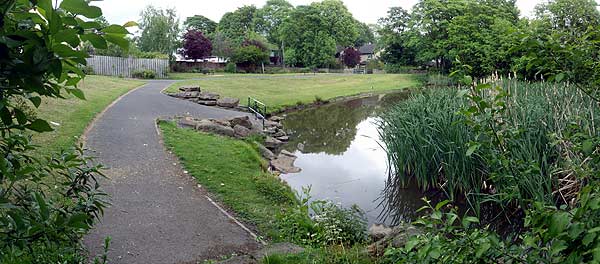
HUNDREDS OF small Cowslips are in flower on the grassy plateau in the centre of Walton Colliery Nature Park, just 2 miles south-east of the centre of Wakefield. I’m impressed by the transformation that has taken place during the past 20 years or so from grey spoil heap to copse, heathy meadow and pond. Now a Local Nature Reserve, it’s probably the best place to see Grass Snake and Adder, although I’ve yet to see either, and for insects, such as the rare Short-winged Conehead bush-cricket which astonished conservation volunteers when they came across it last summer; this species had previously not been recorded in Yorkshire for 80 years. It shows how creating the right habitat (with perhaps a bit of help from global warming!) can benefit wildlife.
This particular Cowslip, Primula veris, growing at the foot of the slope, was bigger those in on the plateau. The lusher growth might be the result deeper soils, resulting from rainwash on the slope and it may be that, down here in the dappled shade of a copse of sapling broadleaf trees, there’s more shelter from wind and sun.
Cowslips are typically found on limy soils. I always imagine that former colliery spoil heaps would give rise to acid soils but there’s more to the coal measures than sulphur-rich coal; sometimes shale can be lime-rich. Mussel bands from the coal measures, as the name suggests, can be stuffed with lime-rich fossil shells. However, growing amongst the Cowslips was Sorrel, typical of acid soils and with leaves that have an acid taste.

Earthballs


IT PROBABLY doesn’t show in these low res scans of my sketches but I’ve decided to try pencil as a change from pen. The lighter tone of pencil should make my watercolour sketches less like a coloured drawing as the line should blend in more but, I’ve made the lines darker than they should be here. This branch of Field Maple, Acer campestre, (above) currently in flower (those little greenish yellow bobbles) seemed like the ideal subject until, after I’d drawn the first leaf, the branch kept bouncing in the breeze.


As a change in my watercolour of the cliffs, I started directly with my brush, with no preliminary drawing, painting the shapes of sky, cliff-top and sea separately, as if they were individual pieces of a jigsaw. A contrast to my habitual pen plus wash, which I used in my quick sketch of Howden Minster on our coffee break on the way here this morning.
I’VE DRAWN these Desirée red maincrop potatoes with a size no. 111 Tower Pen nib that I used when I drew my new art-bag the other day in non-waterproof ink; a sepia calligraphy writing ink from the Manuscript Pen company of Highley, Shrophshire. This flows more smoothly than Indian ink but the disadvantage is that I don’t now have the option of adding a watercolour wash to my drawing – not unless I’m prepared to see my line-work run unpredictably into the watercolour, which in this case is not the effect that I’m after.
WHEN CHECKING out my Middleton Park route for Walks in the Rhubarb Triangle, I was intrigued by the sign for a cycle-path route to the centre of Leeds.

It’s the first day of spring but it seems more like summer this afternoon. Woodland flowers are showing; the odd clump of delicate Wood Sorrel holds its clover-like leaves folded back. The the banking beside the path is dotted with Lesser Celandine and green swathes of Dogs Mercury. The leaves of Bluebells are already showing. As we approach Leeds the rough ground beside the path is dotted with Coltsfoot.
THE TROUBLE with having a big cut-back in the garden is that you end up with a big pile of trimmings, but it isn’t quite as bad as it looks; two thirds of that pile is material from the old compost bins (right) which I now need to put back in the new, much-improved version which we’ve constructed behind the greenhouse.
Now would be a good time to start a crop of mixed salad leaves in the greenhouse, which we’d take out in about two months time when the tomato plants will go in.
I should also be able to whittle down the quantity of black plastic water-tanks that are lying around at the end of the garden; the existing water-butts connected to downpipes from the roofs of the house, the greenhouse and the shed should provide enough rainwater for all but the driest summers.
IT SEEMED rather drastic when, a few years ago, spiked fences went up around the old colliery railway embankment that crosses the valley floor between the canal and the river at Addingford. It blocked off an unofficial walk that I had enjoyed since the tracks were taken up in the late 1960s and, alarmingly, a number of Silver Birches were chainsawed and left lying where they fell, but from the official public footpath, which runs along the foot of the embankent, I can now see this from the birds’ point of view.
does keep them out but whoever put up the fence has gone to a great deal of trouble to ensure that the four-legged friends of humans can’t get in there to enjoy snuffling around in the undergrowth. Bad news for dogs but good news for ground-nesting birds.
Even the felling of a dozen birch trees isn’t necessarily a disaster for wildlife; it has opened up sunny spaces on the banking which should encourage the growth of wild flowers, which in turn should attract butterflies. Ants should also be active on this sunny slope which provide food for a bird that I’ve seen for years near the old railway; the Green Woodpecker.
Leaving the birch trunks where they fell also makes good sense; dead wood is so often cleared away from public spaces and forestery plantations, removing a potential habitat for all sorts of wildlife.
I noticed that several of of the birch trunks, sawn off at chest-height, which is not the approved way to coppice them, have been adopted as bird feeding stations by having planks nailed to them. The resident Robins seemed happy with this arrangement.
The fenced-off embankement wouldn’t walk away with the gold medal for a wildlife garden at Chelsea but as far as habitat goes it’s shaping up to be an improvement for birds, butterflies, wild flowers and fungi.


Too much of a temptation for this black and white cat which was taking it’s usual shortcut back from the meadow via our back garden path. You can see (below) that at times it turned its back on it but then thought ‘Well, just one more go . . .’