DESPITE THEIR NAME, I don’t often see Common Gulls in West Yorkshire, or perhaps I mistake them for Black-headed Gulls in winter plumage, so I take the opportunity to draw a birdwatcher’s field sketch when we see one on the sea wall by the old ferry ticket office at Merkinch Local Nature Reserve, where the River Ness reaches the Beauly Firth.
Helpfully a Herring Gull flies down to give us a size comparison. Looking in the book, the only character that doesn’t match is the ‘dark bill’. The Common Gull has a yellow bill in summer but by now this will be getting duller with a darker ring near the tip. I notice that, even in my quick sketch, I haven’t shown the bill to be as dark as the eye or wing bars. Seeing it against the sea might also have made it appear a little darker than it was.
Tidal Pools
Herring Gulls, Curlew, Greater-Black Backed Gull, Oystercatcher and Redshank were amongst the birds feeding, or just loafing about, by the tidal pools of the bay between the old ferry and the breakwater where the Caledoniaon Canal enters the Beauly Firth.
Channelled Wrack
There’s a band of seaweed along the lower half of the sea-wall. At the top edge of this there’s Channelled Wrack, Pelvetia canaliculata, which has swollen ends to its fronds. These are the reproductive bodies. You can see the channels that give this seaweed its name on the underside of the fronds in the lower left of my photograph.
Spiral Wrack
Growing in a band below the Channelled Wrack, Spiral Wrack or Flat Wrack, Fucus spiralis, also has swollen tips but these are usually in pairs. The fronds have a tendency to twist, hence the name and, unlike the Channelled Wrack, they have prominent midribs.
Its tough leathery fronds have no air bladders.
Knotted Wrack
Below the Spiral Wrack, at the foot of the sea-wall, Knotted Wrack, Aescophyllum nodosum, spreads out onto the beach. It is also known as Egg Wrack because of those egg-shaped air bladders.
Polysiphonia
Looking amongst the Knotted Wrack on the beach, I found this red seaweed growing attached to one of the fronds. The three wracks are Brown Algae but Polysiphonia lanosa (it doesn’t have an English name) is a Red Alga.
Edible Winkle
Lying amongst the Knotted Wrack and Polysiphonia were shells of the Edible Winkle or Edible Periwinkle, Littorina littoralis. This gill-breathing sea-snail (a mollusc that is a member of the subclass Prosobranchia) feeds on seaweed.
If the world is yours, the people of the world are yours too.
Gaelic proverb on the wall of the Cuach Coffee Shop, Inverness Museum and Art Gallery. (A Cuach or quaich is a shallow, two-handed drinking cup, still used on Burns Night in Scotland)
DOES THIS PROVERB mean that if you go out into the world and become a part of it people will accept you and welcome you? It could just as easily be the motto of Cináed mac Ailpín (Kenneth MacAlpine), “The Conqueror”, the ninth century King of the Scots who is reputed to have conquered the Picts.
Inverness, known as ‘the Capital of the Highlands’ is the only capital city that I know of where you can look down from a bridge and see the bottom of the river.
10.25 a.m.: A juvenile Herring Gull wheels down to the grassy bank on the far side of the river to peck and preen, oblivious of the people walking past yards away on the pavement at the other side of the wall. My sketches suggest that this is a juvenile that fledged last year because its back is beginning to turn grey (top left). In a first year bird, the back would be entirely mottled brown.
Some of the litter bins have posters on them asking you not to feed the gulls. The gulls are streetwise, hanging around on the bustling pedestrianised high street of the city, on the look out for scraps. They can recognise a bag of teacakes from a hundred yards away; a man and boy walk past, the man holding a white plastic bag of teacakes (for human, not gull, consumption) and soon three gulls and two crows appear.
These crows are black like the Carrion Crows we’re used to seeing in Yorkshire but we also see Hooded Crows which are grey with black head, breast-patch, wings and tail. Seeing this race of the crow always makes me feel that I’m in the Highlands. They’re also the crows that you’re likely to see in Europe to the south and east of the Alps. We see a number of hybrids of the two races.
An immature Grey Heron watches then strikes. I can’t see whether it actually caught a fish but I suspect that it did as it then wiped each side of its bill against the branch that it’s standing on.
Three Herring Gulls swooped down on the Heron and half-heartedly tried to dislodge it from its perch. They then took up look-out posts on the tops of buildings overlooking the river.
I’M WORRIED about my local patch of countryside. What’s there to worry about, you might ask; the old railway marshalling yards at Healey Mills were featured on a BBC Natural World film as a superb example of butterfly habitat; the Strands and the Wyke made it into the national press as a unique wetland area (the first place in Britain that wild White Storks have nested after an absence of 600 years) and, crucially for biodiversity, these Calder Valley habitats are linked to the Yorkshire Wildlife Trust’s nature reserves at Stoneycliffe and Stocksmoor by Coxley Beck – the only stream in the area with a population of bullheads – and the much-loved woods of Coxley Valley.
Well that’s just how naturalists like myself, local people and the national media see it. This particular stretch of the Calder Valley is also a literary landscape; it features in the novels of the late Stan Barstow who was born in Horbury. Addingford Steps on the path down into the valley take on a symbolic significance in a couple of his novels where characters move from their everyday urban existence to an inkling of a new life with a deeper meaning. I think that’s what a patch of countryside on our doorstep does for a lot of us. It gives us somewhere to think, to forget our everyday concerns for an hour or so.
The valley was where I roamed with my friends as a child and where I set out with my sketchbook as an art student to draw plants, birds and animals.
So much for stories and inspiration; planners and politicians take a different view:
How a Planner might see the Calder Valley
There’s currently a major review of planning legislation in England. We need to get the country’s economy back on it’s feet so the suggestion is that any planning application that can be shown to promote sustainable development should be approved unless it has environmental implications.
But the habitats that I have described above don’t enjoy any special protection. In that sense, they have no special significance in planning legislation. On paper there would be no environmental implications; we’re not talking about a National Park or a Site of Special Scientific interest. None of these habitats, despite their national fame, is recognised as a Local Nature Reserve (not that they enjoy any special legal protection). Approval of applications would, presumably, be automatic.
In the south of England the most biodiverse nature reserve in the country is on brownfield land. At the Olympic site in London, efforts have been made to integrate meadows and watercourses into the design.
We can encourage biodiversity in planning but only if local people, who know the area best, are encouraged to contribute to the planning process. The presumption in favour of development would make it almost impossible to save habitats like these.
OUR LONG SPELL of mainly dry weather has ended with a good drenching which we’re hoping will persuade the runner beans and courgettes to spring into action again. At least the dry spell has meant that we’ve had plenty of raspberries ripening.
In the heavy rain at 5 a.m. yesterday morning, the electricity went off and we didn’t get it back until 12 hours later. Fortunately we have a gas hob (and a whistling kettle standing by for such emergencies!) so we were able to turn the ripe Victoria Plums that my mum had given us yesterday into 6 lbs – ten jars of various sizes – of jam. We’re getting used to not over-setting it.
I HAVEN’T noticed this inscription before, on a stone on an old wall by the car park on Tithe Barn Street, Horbury. In my photograph of the wall (right), you can just make out the spire of St Peter’s Church in the background. The barn where the church tithes – traditionally one tenth of the village’s harvest – were gathered stood a little to the left of this photograph. Unfortunately the barn burnt down in the early years of the 20th century and all that remains of it are timbers built into a wall behind a brick-built house that stands on the site.
I wonder if the inscription ‘C C 1831’ could have been made to mark a boundary at the time that the common fields of the village were enclosed. The area now occupied by the car park was once Horbury’s cemetery, which I assume was established here at about the time of the enclosures. The original churchyard must have been full to capacity by then. As a schoolboy I remember that the wall extended around the area alongside the road (and had an opening to a urinal built into it). There were old headstones and table tombs in what was by then a rather overgrown cemetery. Many of the remains were re-interred in Horbury’s newer cemetery, opened in Victorian times on Hall Cliffe, a quarter of a mile to the north, when the red shale car park was made in the 1960s but I believe that some of our Horbury ancestors still rest in peace under the car park.
Reception
I don’t know what makes a noticeboard, the back of a monitor and a pile of bags so compelling but I find the view of the back of the reception desk in the health centre an enjoyably absorbing subject to draw.
THIS MORNING I spotted a Kingfisher flying to a perch on a branch on a pebbly bank at the edge of the river by the Bingley Arms. It spent a minute or two bashing the small fish it had just caught against the branch.
It watched from the perch for a while then dived down into the shallows beneath, emerging without catching a fish. Back on its perch but looking the other way, it watched, then dived again, once more without success, before flying off downstream.
It’s a long time since I saw a Kingfisher and I don’t remember ever seeing one dealing with a fish but it’s good to know that they’re still about.
Monkeying about with Elements 5
As I listened to the radio, I started doodling on the back of an envelope. Envelopes are often pleasant to draw on, smoother than the cartridge I’m used to but still with enough grain on the surface to provide some character.
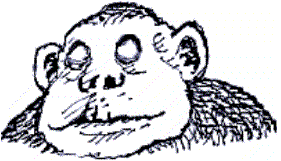
I’ve recently loaded up Photoshop Elements 5 on my computer. It came bundled with the scanner but I’ve never given it a try. I’ve yet to find a program that makes animated GIFs as simple as they should be. The Elements version won’t allow me to vary the speed between frames so this ape is doomed to roll his eyes continuously at a rate of 0.2 seconds between frames.
22°C, 5.50 pm. THESE PIECES of sandstone at the corner of the pond provide access to the water for birds and perhaps some cover for newts and frogs. They also help disguise the edge of the black plastic pond-liner. The first pond that we dug when we moved here was lined with builder’s damp-proofing plastic – blue polythene sheeting – which wasn’t resistant to ultra-violet light. I covered the edges with turves and spread garden netting across the bottom of the pond and pressed sub-soil from the hole we’d dug into it. This produced a more natural-looking pond than our present one but it had a tendency to wick water away and the netting wasn’t a good idea; on one occasion I saw a frog that had been drowned when it had gone down into the mud and got caught in it.
Brachiopods
I noticed these impressions of fossils shells in the rock on the far right (top). Superficially they look like cockle-shells but these fossil creatures weren’t bivalve molluscs; the Brachiopods (the name is from the Greek meaning ‘arm-foot’) appeared in the Cambrian explosion of life on Earth and have been around for 570 million years. Three thousand fossil species have been described but today only about 100 living species remain. They have suffered from competition with bivalves such as cockles, oysters and mussels.
Modelling clay cast of brachiopod. I can't decide whether this is a complete shell or whether these are two valves from separate individuals which just happen to have fossilised together.
These fossils are negative impressions of the shells so I pushed a piece of modelling clay into the hole and made this positive cast of the original shell. When this shell was last visible on the surface of the earth it was on the seabed at a time when our part of the Earth’s crust lay close to the equator, some 300 million years ago in the Upper Carboniferous period. As the fossil is in sandstone, I guess these brachiopods must have been living near the mouth of a river.
The ribs on the shell bear this out as they indicate that this species of brachopod was adapted to live in shallow water in a strong current. A smooth shells would indicate a species that lives in deeper, calmer waters. That zig-zag line which marks the opening of the shell is known as the commisure (below right); brachiopods developed a folded commisure to increase feeding area while preventing sand particles entering.
Brachiopods stood on a pedicle stalk anchored on the seabed and opened and closed the two valves of their shells to feed. The hole in the shell where the stalk protruded led to them being given the name ‘lamp-shells’, as the larger valve resembles a Roman oil-lamp, with a hole for the wick.
THE WILD GLADIOLUS, Gladiolus ilyricus, is a native of south and west Europe but is considered to be a native of the British Isles with a very local distribution in the New Forest where it grows on acid grass heaths. The showy variety that I’ve drawn here is a florist’s variety of the plant, perhaps the Italian Gladiolus, Gladiolus italicus, which is the one most often grown in this country. It is sometimes seen growing as a garden escape on rubbish tips.
As you might guess, the name comes from the same root as ‘gladiator’. Gladius is the Roman word for a small sword; the name refers to the shape of the leaves.
Gladioli are members of the Iris family and I can see the resemblance to Yellow Flag.
THIS RELATIVE of the dandelion grows around the edges of the lawn, mainly on the shadier side. It tends to be larger than the Autumn Hawkbit which I drew the other day. It’s leaves aren’t as narrow as those of the Hawkbit and the teeth of Cat’s-ear don’t point backwards.
Cat’s-ear, Hypochaeris radicata, is a plant of meadows, heath, dunes, lawns and roadsides, on mildly acid soils. The ‘cat’s ear’ of its name refers to the scale-like bracts on its stem.
WRITING the labels for our latest batch of jam – Victoria Plum, which we picked from my mum’s tree on Thursday – gave me the perfect excuse to try out another colour from my new set of Winsor and Newton inks to write the labels. The bottle of purple ink has an illustration of a plum on the label but it’s a purple Damson, not a light red Victoria Plum.
This second illustration is drawn with a Q Connect fineliner with an 0.4 tip; an ordinary office pen. Both the Winsor and Newton ink and the ink of the fineliner penetrate to the reverse side of the soft, absorbent cartridge pages of my current sketchbook. I’m looking forward to finishing this sketchbook – a Crawford & Black 96 gsm acid free A5 portrait sketchbook from The Works discount store – and getting back to a more ruggedly made Pink Pig sketchbook but there’s still half the pages to go and I can’t waste them; it’s acceptable for everyday use but I have another sketchbook on the go for when I have a day out drawing.