Spring Gentian

 DREW THE bluest of the gentians on Männlichen, the Spring Gentian, Gentiana verna, then set out again on the Panoramaweg in what we thought would be a brief shower but which turned into rain. We dried out by stopping at a mountain restaurant for soup and a roll.

1.30 pm, Kleine Scheidegg station.

The Alpine Choughs have very dark eyes, which don’t show up at any distance like those of our Jackdaw. Perhaps the dark pigment in the eye acts as a U.V. Filter.

2 then 3 or 4 choughs descend on plates of noodles and spaghetti as soon as they are left, casting plastic forks and paper serviettes aside before throwing the paper plate itself onto the ground.

We take the train down to Grindelwald Grund then return back up via the gondola to Männlichen. We can’t resist fitting in our marmot-spotting journey just one more time.

A buzzard circles in a clearing amongst the tall conifers, giving us a view from below, then on level with (we can see the details of its eye and cere) and finally from above. As we glide past in our gondola it’s like being in a wildlife documentary where they film at treetop level from a microlight.

Some of the conifers are the height of our electricity pylons and in proportion as long and thin as slender pencils. Very long slender pencils. Some have bunches of long purple cones, similar to the weights on traditional cuckoo-clocks.

We spot only one marmot, sitting like a sphinx, looking uphill but as a final bonus a red kite gives us a fly-past just as we near the upper station. Like the buzzard it gives us a perfect, unhurried diagnostic view, enabling us to see the shallow ‘V’ of its wings as it glides towards us, then the markings as it dips below us.

No Chamois today but flock of Alpine Choughs dip down to the cable car, as if in a farewell salute, then fly off over the crags.

6.30 pm, After all the travelling around, looking at wonderful scenery during this wonderful two week holiday, I realise that I would have been equally happy to have been fixed in one spot, taking a close look at the birds, butterflies, flowers and fossils. Perhaps next time I should go to a small island!

I draw these wild flowers in the meadow by the children’s play area in Wengen. It’s on an embankment with a retaining wall, so I don’t even need to bend down to draw them. My varifocal spectacles are perfect for this kind of work with flowers and my sketchbook both comfortably in their focus zones. I find myself using a fine no.1 tipped Pilot Drawing Pen and adding small-print notes to my drawing, as I did 30 years ago when compiling my Richard Bell’s Britain sketchbook.

The flower on the left is a bellflower, Campanula rhomboidalis, which is found in the Alps and the Jura up to 2200m in meadows and on grassy banks.

On the right is a species of scabious, either small or shining, S. columbaria or  S. lucida.

The Spiked Rampion, in the middle, is a member of the bellflower family but it lacks the showy bells of its relative. Instead it has this plume-like flowerhead.

The Marmot’s Tail

 Friday (Freitag), 10 (zehn) June (Juni)

Sound of whistling – repeated 2-note phrases – as we passed over the marmot burrows. These two appeared to be keeping watch on some walkers 100 yards away.

Seen from above the marmot has a tail as thick as a German sausage – thicker in fact – with a black tip.

A stand-off – who will come out on top? –

A pair of Ravens or the mighty marmots – Europe’s largest member of the squirrel family?

No contest; one Raven pecks the tail of one of the marmots, which scampers off and stands right next to its bolt hole. The other marmot likewise stands beside a hole while the Ravens continue to strut along as the cocks of the walk.

Some of the marmot holes are enormous – perhaps where multiple tunnels have collapsed into each other.

Romantiweg

Pipit, Alpiglen

The Wengen-Männlichen gondola was back in operation again yesterday after repairs to the supporting cable following a lightning strike so this morning we were on it at about 9, up in the high Alpine grasslands about ten minutes later and before 10 we’d made our way to a little knoll on the north end of the Männlichen ridge that gives views of all the places in the vicinity that we’ve visited – Interlaken, the Alpine Garden at Schynige Platte, Grindelwald, and the Lauterbrunnen Valley, although this morning cloud blotted out the Jungfrau.

Drogerie, Grindelwald station

After coffee at the restaurant we followed the Romantiweg – the Romantic Footpath – across the slopes down to Alpiglen, making slow progress as there were so many different species of wild flower to stop and try to identify.

Chamois 

On our return descent to Männlichen, in a cable car filled to capacity, we were able to position ourselves on the north side of the cabin so that we could see the area that the Chamois Trail footpath goes through on a steep upper slope where narrow meadows streak down between phalanxes of conifers. We were in luck; we saw our first Chamois. Well, actually I’d just decided that it was an odd-shaped sandy grey boulder lying by the path when Barbara spotted another 10 yards away from it, making its way along the path into the forest. We could make out the general shape through binoculars but not whether it had horns.

My close up of the Chamois (right) was of a stuffed specimen in a glass case in the lower cable car station. It was larger than I imagined; the size of a goat.

A day or two later we got a better view of a single Chamois, spotted by a sharp-eyed Australian as we waited for the cable car to descend. It was standing at the foot of the grassy gulley/clearing that runs below the cables. That one definitely had horns.

Mist over Männlichen

6.30 pm; These lower pinnacles of Männlichen were soon completely swathed in cloud when I started adding the watercolour to this little sketch made from our balcony. It’s now raining heavily (rather than torrentially) but it’s also brightened; there’s an overall yellowish hue to the meadows and chalets of Wengen, below the increasingly misty mountain above. The light is similar to the yellow band in a rainbow.

Kleine Scheidegg

THIS MORNING, for the first time, we’ve taken the uphill train from Wengen to the terminus at Kleine Scheideggat the top of the pass, a station that reminds me of the Tintin stories, with mountain railway trains, some of them charmingly vintage, arriving from three directions and a constantly changing cosmopolitan throng of people embarking and disembarking, some of whom I could imagine having walk-on parts in Hergé’s comic-strip adventures of the globe-trotting Belgian boy-detective. The absent-minded Professor Calculus and the comically but heroic Captain Haddock might appear at any moment. The dapper ticket inspector shepherding passengers onto the ‘Top of Europe’ train would be perfect in a cameo role and these Alpine horn players might add a touch of local colour.

They set up their 3 or 4 metre long instruments on the hillock behind a large tepee which serves as a beer tent. The calm, mellow notes of the horns carry well in this mountainside setting. There’s a subtle play of harmonies when you hear two horns together. It’s a reflective, nostalgic kind of sound, with a hint of sadness about it to my ears; not the audacious bull-roar that you might expect from such a monster of an instrument.

Alpine Chough

If this was one of Hergé’s stories, by now Snowy (or Milou, as he’s called in the original Belgian version), Tintin’s dog, would have slipped away from the performance to team up with a St Bernard in the beer-tent to drink the contents of its brandy barrel. Thieving magpies feature in one of the Tintin stories but in this mountain setting their place is taken by streetwise Alpine Choughs, one of which surprises Barbara as she’s sitting writing her journal by flying down to the table, right beside her, to check for scraps.

Alpiglen

We walk down from Kleine Scheidegg towards Grindelwald, the holiday village in the valley below the Eiger, photographing wild flowers as we go. Alpiglen, halfway down, is perfectly placed for our lunch stop (Goulash Soup, right).

Through the window, beyond the window box filled with geraniums, there’s a view of the lower slopes of the Eiger. The peak itself towers way out of sight above the window and, this afternoon, is lost in the clouds.

Most of the roofs in the small hamlet of Alpiglen, and many elsewhere in the area, are clad with wooden shingles, often with a metal ridge along the apex.

Fieldfare and Swallowtail

This thrush-sized bird has us puzzled. In my notes, I record it at 2.20 pm by broad-leaved woodland edge (we’re well down the mountainside now) by a meadow with Globeflower, mallow and trefoil. We’ve seen it several times but it wouldn’t be until after our holiday, when I looked it up in the bird book at home, that we realised that it’s a Fieldfare. I assume that when I noted that its breast was ‘white’ I was getting a partial view as the breast of a Fieldfare is spotted. In Britain Fieldfares are winter visitors, in the Alps they can be seen throughout the year.

The swallowtail butterflies are easier to recognise.

Apple Fritters at Brandegg

Our final stop before getting on the train for the rest of the journey is at Brandegg, where the restaurant makes a speciality of apple fritters. We sit outside and I draw this view looking north across the valley towards the hamlet of Bussalp, perched amongst the high meadows above those limestone cliffs.

A Buzzard circles high above the valley to the west, descending into the forest. A Redstart, with a breast the colour of ‘rust washed with saffron’ according to my note (I’ve been adding the colour later to these bird note sketches), sings from the gutter at the corner of the restaurant. Cow bells ring like a laid-back gamelan ensemble in the surrounding meadow.

As we walked down the track between Alpiglen and Brandegg we heard a noise as if a train was coming towards us along the nearby track. It built to something more like thunder or distant gunfire. We looked up to the north face of the Eiger to see an avalanche coming down, funneled into gullies on its way so that you might mistake it for a waterfall but it was more like the sand in an egg-timer. As it came down from one terrace it built up a pile – as an egg-timer does – below. When this became unstable the avalanche continued down to the next level, sometimes forking to descend down two gullies.

Climbers on the Eiger prefer to set up camp and take a break during the afternoons to avoid the avalanches that are then likely to start.

This long-horned beetle flew onto the fence between our table and the meadow. It was about 2 inches long including the antennae.

Jungfrau

This is the view of the Jungfrau (4158 m., 13642 ft) from our balcony at the Bernerhof Hotel, Wengen. Most evenings it was partially, or entirely, lost in cloud.

Nest Robber

A COMMOTION before breakfast; six Blackbirds and a Mistle Thrush are gathered in what looks to me like indignant rage around a Magpie on the back lawn which is down at the edge of the pond, attacking a plump nestling, pecking at its head. I know that I should no more wish that Magpies wouldn’t take the chicks from ‘our’ back garden nests than I should wish that Osprey’s shouldn’t swoop on trout or that lions shouldn’t attack zebras but it’s difficult not to feel involved as this turns out to be chick from a Blackbird’s nest in the Ivy behind our herb bed.

We’ve been following the progress of the parents’ nest-building and feeding from the kitchen window, only yards from the nest. They’ve been busy over the past few days shuttling in a supply of worms and insects.

Deciding that it would be too late to rescue this chick anyway, I leave the garden birds to sort it out between themselves.

But, after breakfast, when I go down the garden to open the greenhouse, I discover a second chick. It looks like a miniature oven-ready chicken, naked, plump and bleary-eyed, with a row of plastic-looking quills along its stubby wings. Only it’s parents could love it. It’s got a spot of blood near the base of its bill but is otherwise unscathed. The Magpie must have been disturbed before this chick suffered the fate of its sibling, which the Magpie carried off down to the vegatable beds to finish eating.

I put my head into the Ivy and with some difficulty spot the nest, on a twining branch on the far side of the hedge. With a stick I poke away the remains of a third chick, hanging over the nest from a twig, which the Magpie had evidently killed in its attempt to make off with it.

I retrieve the surviving chick from the lawn and place it so that it’s as comfortable as it can be in the nest. It’s still warm and, I guess, healthy enough.

I’m anxious that the parents will have desserted the nest but by the end of the afternoon they’re back again, so it looks as if they’ve found the youngster. A day later male and female are still taking turns to pop in with food so it looks as if the Magpie hasn’t been back . . . so far.

Wigeon Sketches

I’VE GOT a mental image of the Wigeon but I realise, when I start drawing the real life bird from the Main Hide here at Anglers Lake, that it doesn’t quite fit. For one thing, when I see this drake from in front I can see that its head is more rounded than I imagined. And I’ve over estimated its size; when this drake swims close to on the shore I’m surprised to see that the he is the same size as a Tufted Duck that is loafing by the water’s edge. The size ranges of the two species overlap but in general the Tufted is the smaller species.

Angler's Lake from the Main Hide

It’s only after I’ve been drawing for a while that I realise that this drake has a companion; the female. As I’ve written in my note she ‘easily blends into the background of grey, rippled water and stony banks’. But she does make her presence known when a rival female swims by. It’s the duck rather than the drake who challenges the rival.

Penelope’s Web

The Latin name for the Wigeon is Anas penelope. In Greek mythology penelops  was a sacred bird, a purple-striped duck. Penelope is better known as the wife of Odysseus who stayed faithful to him during his 20 years away, fighting in the Trojan War and on his protracted voyage home. Her determination in dealing with rapacious suitors in her husband’s absence seems to fit with this female Wigeon’s behaviour. One legend has it that Penelope, daughter of Icarius of Sparta, was exposed at birth – the traditional Spartan way of weeding out any weaker offspring – but she was rescued and nurtured by penelops the duck.

But I wonder if the connection between the Wigeon and Penelope actually refers to the web-like pattern of the female. Penelope promised that she would choose one of the suitors as her husband when she had finished weaving a shroud for her father-in-law. Secretly, she unravelled her weaving every night so ‘Penelope’s web’ has become a phrase for any project that is indefinitely delayed. A possible derivation of the name Penelope comes from the Greek for ‘web-face’ or ‘weft-face’.

North Landing


IT’S SO WINDY here at North Landing, Flamborough, East Yorkshire, that even the gulls are having difficulty making any progress inland; a gull version of Marcel Marceau’s ‘walking against the wind’ mime. A flock of pigeons is no more successful; they wheel around over the bay and veer off on a less wind-buffeted course.

Flamborough Head marks the border between sea areas Tyne and Humber, pointing out towards Dogger in the centre of the North Sea and German Bight on the far side.

Strong winds tend to bring seabirds in towards this six mile promotory of chalk cliffs, making it a favourite location for ‘seawatching’ but unfortunately today it’s blowing in the wrong direction. If it’s blowing from any direction between north-west and east it can bring gulls and auks, skuas and shearwaters closer to the shore but today it’s blowing from the south-west, tending to keep them out at sea.

You might expect to a lot of white-topped waves in such a strong wind but it seems to have the opposite effect, flattening the crests before they become top heavy. At the foot of the cliffs there’s an effect like beaten brass where gusts bring turbulence down to create temporary patches of smoother sea.

As a change in my watercolour of the cliffs, I started directly with my brush, with no preliminary drawing, painting the shapes of sky, cliff-top and sea separately, as if they were individual pieces of a jigsaw. A contrast to my habitual pen plus wash, which I used in my quick sketch of Howden Minster on our coffee break on the way here this morning.

The Barn Owls of Low Laithes

This Barn Owl was found lying by the side of the M1 near junction 40 earlier this week. A member of the Wakefield Naturalist’s spotted it and brought it to the meeting on Tuesday. Sadly, this if a first; at the meetings of the Wakefield Naturalists’ Society that I’ve attended over the last 40 years, I don’t ever remember anyone bringing in a dead bird but this was apparently a regular feature of the society’s meeting in the Victorian period in the bad old days when one of the axioms of keeping biological records was ‘what’s hit is history, what’s missed is mystery’. Even some of the founding fathers of conservation like Audubon used the gun to collect huge numbers of birds, and not just strictly for reference purposes when illustrating his Birds of America, he apparently enjoyed the sporting aspect of shooting wild birds.

There’s a record of an Otter which was shot on the Calder at Stanley on 3 February, 1869. Rather worryingly there’s a note in the Wakefield Naturalists’ Society Annual Report for 1883 (illustrated here with an engraving by Thomas Bewick, or one of his followers):

 Otter – Lutra vulgaris. Several have been obtained.

The Wakefield Naturalists’ Society was founded in 1851, ten years before the Yorkshire Naturalists’ Union, which celebrates its 150th anniversary with a conference on The Ever-changing Flora and Fauna of Yorkshire at Garforth on 19 March this year. Obviously there had to be a network of naturalists’ societies before a county-wide Union could be formed.

Coming back to the unfortunate Barn Owl; it’s hunting habits, flying low over open, scrubby grassland, in the half-light of evening are sooner or later going to put it on a collision course with motorway traffic. Low Laithes golf course provided a hunting territory for Barn Owls as their numbers began to recover locally in the 1980s. They’re continuing to spread around Anglers Country Park today.

Appropriately the place name Laithes comes from the Viking word for barn. My Walks around Ossett follow circular routes around the town from Mitchell Laithes in the south-east to Low Laithes in the north-west.

When I was checking out the Low Laithes walk for the booklet, I came across a familiar-looking image of a Barn Owl. Flags and signs at Low Laithes golf course are emblazoned with the owl logo I drew for them back in the late 80s or early 90s. It’s even been carved in bas-relief in sandstone by the entrance gates; the first time I remember anything of mine being carved in stone.

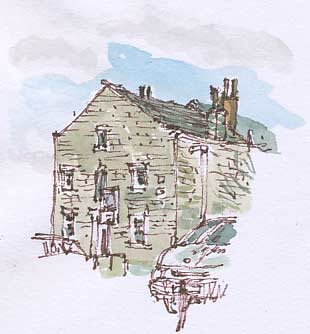
End of terrace on the junction of New Street and Prospect Road, Ossett, drawn during a coffee break at Cafe Vie.

Scrubland

The Runtlings, Ossett; The winter hedgerows are busy with birds: Greenfinch, Great Tit, Long-tailed Tit and – probing the leaf-litter beneath trees – a few Redwings. A Kestrel hovers over the rough, grassy mounds on waste-ground around Dewsbury Sewage Works.

In my childhood, rough grassland dotted with thorns was a familiar habitat around old collieries, factories and railway sidings. Much of this ‘brown land’ has now been reclaimed for housing and office parks, and today, when more thought goes into landscape design, areas that would once have been left as derelict have been transformed into community parks with fishing ponds, copses and little meadow areas but, because of my childhood memories of roaming around post-industrial landscapes, I feel a touch of nostalgia for these pockets of unkempt scrubland, the hunting ground of the Kestrel.

Towpath Birds

Each bird has it’s distinctive way of getting across the canal;

The Moorhen has the most amphibious method, combining land, air and water for the short journey. As it sees us approach, it pauses on the towpath, stalks a few tentative steps to the bank, launches itself into the air with limited effect then staggers along the water surface for a few paces – with the out of control momentum of someone jumping onto the platform before the train has stopped – before settling to swim the last yard or so to the seclusion of the bankside vegetation.

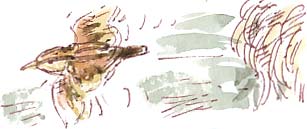
The Wren zooms along, wings a-whir, from the undergrowth on the towpath side to the hedge on the far bank.

A small group of Long-tailed Tits take a roller-coaster flightpath from the tops branches at one side to those on the other. Repeated wing-beats interspersed with short rests result in their bouncing flight.

A pair of Mallards swim across with a surreptitious air. The drake might be trying to avoid the attention of rival males. Later we see a duck closely pursued by two drakes flying up river.

Birds at a Glance

chaffinchThese aren’t drawings of the birds’ ‘true’, accurate appearance – it would be easier to study a bird book for an authoritative version of that – but they aren’t drawings of the birds as I saw them either; they’re drawings of the way I remembered the appearance of the bird after I’d looked at it for as long as possible, which wasn’t long enough, through binoculars.

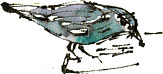
This way of drawing varies from my normal approach where I look and look and look again, building up a drawing from dozens, probably hundreds, of little observations. blackbirdThat’s not an option with most of the birds in our garden. I took mental notes of shape and colour during my one lingering look at each bird and then tried to stick to that, rather than revert to the familiar picture of, say, a Blackbird, that I might already carry in my mind.

I gave myself license not to worry if the final drawing didn’t look all that much like the bird. As I say, I could have referred to a bird book if that had been my aim but these are the colours and the shapes, as accurately and honestly as I could transfer them from memory to paper.

The species I drew are male Chaffinch, Starling, female and male Blackbird, Great Tit and Woodpigeon. I used an ArtPen with brown Noodler’s waterproof ink and Cotman watercolours.