A NEW SKETCHBOOK and, I hope, a new start. I’m pleased to consign my finished 6 inch square sketchbook to the plan chest drawer, dominated as it was by drawings I’d done during visiting time in the cardiac ward and in the hospice. At least I kept up my drawing as much as I could. It’s now four weeks since my mother-in-law’s funeral but it hardly seems it as there’s been so much to do.
With my new sketchbook I’m broadening my outlook; it’s A5, 6 x 8 inches, as a opposed to 6 x 6, so there’s that extra space to breath. More depth, I hope, in dimension and in intention. And I’m feeling the urge to travel . . .
One of the reasons we miss Betty is that she’s no longer there to call on and to tell her tales of our travels – for instance on Friday when we took a relaxed shopping trip into Leeds. But at least we did a lot of travelling with her, when she was fit enough to get about. Even when she wasn’t so fit, for that matter.
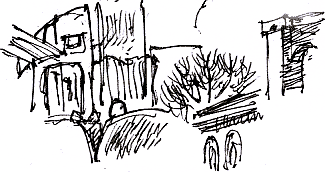
Travelling in by train from Dewsbury is my favourite way to commute to Leeds. There’s no winding about on motorway feeder roads as you approach the city centre. Although it’s such a short journey there’s still enough time to take out a sketchbook and draw the passing scene or – in the long tunnel deep beneath Morley – commuters in the carriage.
I’ve been looking forward to doing the collage exercises in The Professional Step-by-Step Guide to Cartooning(Hissey & Tappenden). It’s so unlike anything that it would normally occur to me to do. The nearest that I get to collage in my sketchbooks is sticking in a ferry ticket or a tea-bag tag when we’re on holiday. I’ve stuck as closely as I could manage to Ivan Hissey’s sample artwork but to do it with his ease and panache I’d have to practice a bit more. Collage calls for forward planning, care and precision. Not my strongest points. You’ve got to look out for things like ragged edges – unless you intend to use a ragged edge – and splodges of glue.
And of course I’ll be in trouble next time Barbara needs to refer to the storage section of our Ikea catalogue!
“That looks twee!” said Barbara as she looked over my shoulder this morning as I was colouring in this cartoon. She’s right, I don’t normally do cuteness, so it’s been a strange experience, working through this cartoon course (see previous posts), as I’m obliged to try and work in someone else’s style. Again, I’ve changed the subject matter; this exercise in colour harmony features a monkey and a pile of bananas in the original example but I thought I’d include the daffodils that are now showing in our garden border and the large ginger cat that has adopted our back garden.
My priorities for the back garden might be attracting wildlife and growing vegetables but the ginger tom sees things differently:
stalking practice; sitting on the patio watching the birds on the feeders
liquid refreshement; using the pond as a watering hole
comfort break; using one of our freshly dug raised beds as the ultimate cat litter tray
This huge, fluffy ginger cat also enjoyed a spot of crazy breakdancing, pouncing this way and that on one of the veg beds like an overgrown kitten at play. The sparrows who normally hang around in the adjacent hawthorn hedge flew up in agitation, chirruping in alarm, apparently unsure what to make of this crazed predator.
Continuing with the cartooning course, these are experiments to test how colours will blend in different media; in my case I used my regular watercolours for the peacock, coloured inks for the rainbow trout and Sharpies and other marker pens for the butterfly.
It’s a rare opportunity to use my Pelikan inks, which have been sitting in the back of a drawer for decades and getting them out makes me realise that I need to sort out my art materials. For instance, the cheap sable brushes that I bought years ago are now too splayed to be a pleasure to use and some tubes of gouache have dried out and set solid.
However, I still have enough tubes of gouache to try the exercise for building up a furry texture using a fine brush and this opaque medium. Apart from changing the species from a bear to a weird kind of furry fox, you can see I’ve stuck pretty much to the examples shown in the book, The Professional Step-by-Step Guide to Cartooning, (left, behind my bottles of vintage ink).
In the next exercise – which demonstrates the way you can use a limited colour palette, in this case red and blue ink – I substituted the cowboy in the book for Roundhead commander ‘Black Tom’ Fairfax, who pops up in my latest booklet Walks around Ossett.
I think that I’ll eventually be able to relax into a personal cartoon style but this drawing looks rather stilted as I was simultaneously following the style of the cartoon cowboy and the content of the equestrian portrait of Fairfax. The fanciful background sketch of Thornhill Hall (accidentally blown up at the end of Fairfax’s siege), which I’ve substituted for the wild west background of the cowboy, looks less self-conscious than the horse and rider.
I came across The Professional Step-by-Step Guide to Cartooning by Ivan Hissey and Curits Tappenden a couple of weeks ago and after the final push of getting my walks booklet into print, I thought that I deserved a bit of a change, so I’m going to have a few days off to go through some of the practice exercises in the book.
My main thing, of course, is drawing from nature, so why should I be interested in cartooning? This book is a practical introduction to drawing as a way of telling a story or communicating an idea, which is what I try to do in my publications. If drawing from nature was my sole concern, I could just as well present my drawings in isolation – framed on a gallery wall, for example – but invariably I present them as a sequence, along with varying amounts of text.
I’m hoping this book will make me rethink the way that I tell stories and communicate ideas in my publications.
Opposing Black and White
This first exercise calls for fineliner pen (I used a Pilot drawing pen) and black Indian ink applied with a number 3 round brush. Starting it in pencil, I’ve closely followed Ivan Hissey’s step-by-step but I’ve gone for a geological context rather than the darkened room of the original. I like the woodcut style, where you aim to balance the black and white portions of the image, but to get the sharp gouged line of a woodcut calls for some confidence and forward planning when you ink in with the brush. In the places where you can still see my drawing pen line it comes over as too soft and tentative for this style of cartoon.
I look foward to getting a bit more practice . . .
Here we are at the Admiral Benbow, the inn where young Jim Hawkins encounters Billy Bones and Blind Pew in Treasure Island. You might detect some echoes of last year’s Dame Dibble’s Dairy from Jack and the Beanstalk, in my sketch; this is because of my habit of recycling backdrops. Instead of starting the scene afresh, I’ve converted the half-timbered exterior of the dairy into the half-timbered interior of the inn.
This gave us time to flip the flats around this afternoon to quickly convert the sky blue scene of Jack’s Cloudland Castle into a tropical Treasure Island with palm trees, dunes and smouldering volcano (a detail that I don’t recall in the Robert Louis Stevenson original).
Spike’s Script?
The first big production of the Horbury Pageant Players that I got involved in was Treasure Island, in 1967, but that was in the days when the Pageants prided themselves on never doing pantomimes so the scripts we used were on loan to us from the Mermaid Theatre, where Bernard Miles’ production had been a great success. In that version, comic genius Spike Milligan played Ben Gunn, the castaway with a fondness for cheese.
In our 1967 version, my younger brother Bill played the pirate who took Jim Hawkins’ kit on board the Hispaniola. Bill told me that one of the scripts had weird figures doodled all over it.
I never saw this script and all the whole batch were returned to the Mermaid after the production but I’m convinced that must have been Milligan’s script, annotated in characteristic style by him during rehearsals.
It would be a small treasure of Milligana if it had survived!
I have been drawing recently but you wouldn’t know it from my sketchbook; these are all I have to show for the last week or two. I’ve been drawing the maps for Walks Around Ossett in the odd hours I’ve had between family matters and parcelling up my books. Parcelling up books and shipping them out to customers never seems like real work – it’s therapeutic but hardly taxing – but it is, after all, the way I make my living, so I shouldn’t grumble!
I think that I can see a patch of calm, clear water ahead but at the moment I really feel as if I’m swimming against a backwash and getting nowhere and that is reflected in this handful of sketches:
a couple of people at the Wakefield Naturalists’ meeting on Tuesday
a newspaper drawn when I waited to have my hair cut last week
two chair backs
The chairs are entirely typical of my unsettled life at present; I started drawing one chair then got moved on after I’d drawn two lines then – at my next port of call – I’d no sooner started drawing a second chair when someone came along and moved it!
Rhubarb Rootstock
Finally, this afternoon, after a morning painting scenery and an afternoon at a farm shop event, I got the best part of an hour to sketch. As it was a Rhubarb Festival event the most appealing subject to hand was a basket of forced rhubarb and an example of the rootstock from which the shoots are grown, at this time of year, in total darkness to ensure an early crop, at a time of year when there is a break in the supply of soft fruits.
You can see why the razor shells you find on sandy beaches get their name when you see old cut-throat razors like these; they have the same proportions and gentle curve. Abalone shell has been incorporated into the grapevine decorations on the handles of these razors. The abalone is ear-shaped with a row of perforations – which would be the effect one of these cut-throats would have on my ear, if I ever attempted to use it!
In Wild Yorkshire on 7 August I wrote about my great-great grandad, Samuel Bergin Swift who designed a cut-throat razor for Napoleon III.
It seems that his son George, my great-grandad on my mum’s side, might have been equally talented. I like to think my enthusiasm for applied arts – if I can include writing and illustrating books in that category – comes from that side of the family. Yesterday, while having a cup of coffee with my mum, we were talking about Samuel Bergin’s designs and she mentioned that she has two cut-throat razors that belonged to George.
They have the maker’s name on the blades; ‘JOSEPH RODGERS&SONS, CUTLERS TO THEIR MAJESTIES, No.6 NORFOLK STREET’; the firm where at least four generations of my family worked. The final line of the address, ‘SHEFFIELD’ is almost entirely worn away.
A collector who has a special interest in Rodgers’ pen-knives and razors tells me:
It’s very difficult to date Rodgers razors but they look to be late Victorian or Edwardian. The reference to THEIR MAJESTIES simply means the fact that Rodgers have been cutlers to George 4th, William 4th, Victoria and so on.
I have never seen decoration like that on a Rodgers razor before and so if you look, the pin at one end is different from the other end. My thinking is that these razors were either bought as standard razor blades and had different handles fitted. Or, the original handles got damaged and were taken off and replaced with these. This would not be unusual.
The very good news is that they have been replaced with some stunning inlaid pique work using possibly pieces of mother of pearl but the majority of it is definitely abalone. It is a much more iridescent and colourful shell than MOP. Your relative who worked at Rodgers would have likely been able to do this work easily or he would know someone who could. I think these handles are one of a kind. It doesn’t make them unique in particular, it just means they are a good example of pique work. Because pique work like this is all hand done, every item is different in some way. The grapes were a popular symbol of art nouveau decoration which makes me think these are late Victorian.
The decoration is superb. I forgot to mention that it looks like there is some inlaid metal in there as well. That would be perfectly normal. The metal and abalone compliment one another. It could be gold or silver, it’s difficult to say without seeing it.
The handles themselves look to be an early bakelite/plastic but it’s hard to say. They could also be buffalo horn, ebony wood or tortoiseshell. I didn’t think so at first but them I remembered that unpolished shell does have a very dark colour to it, especially when it’s thick. I’m sorry I cannot help you more in that handle material. One thing you could do is hold the handle up to a bright light and if i has a browny colour, it will be shell. Horn and ebony tend to have a grained appearance which I don’t think these have. If you cannot see a grain and it doesn’t shine brown through a bright light, I would think they are bakelite.
Because the handles are mounted on metal, I haven’t been able to shine a light through them. Along the edges, I can’t see any signs of them being translucent.
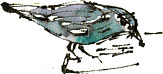
These aren’t drawings of the birds’ ‘true’, accurate appearance – it would be easier to study a bird book for an authoritative version of that – but they aren’t drawings of the birds as I saw them either; they’re drawings of the way I remembered the appearance of the bird after I’d looked at it for as long as possible, which wasn’t long enough, through binoculars.
This way of drawing varies from my normal approach where I look and look and look again, building up a drawing from dozens, probably hundreds, of little observations. That’s not an option with most of the birds in our garden. I took mental notes of shape and colour during my one lingering look at each bird and then tried to stick to that, rather than revert to the familiar picture of, say, a Blackbird, that I might already carry in my mind.
I gave myself license not to worry if the final drawing didn’t look all that much like the bird. As I say, I could have referred to a bird book if that had been my aim but these are the colours and the shapes, as accurately and honestly as I could transfer them from memory to paper.
The species I drew are male Chaffinch, Starling, female and male Blackbird, Great Tit and Woodpigeon. I used an ArtPen with brown Noodler’s waterproof ink and Cotman watercolours.

 A NEW SKETCHBOOK and, I hope, a new start. I’m pleased to consign my finished 6 inch square sketchbook to the plan chest drawer, dominated as it was by drawings I’d done during visiting time in the cardiac ward and in the hospice. At least I kept up my drawing as much as I could. It’s now four weeks since my mother-in-law’s funeral but it hardly seems it as there’s been so much to do.
 One of the reasons we miss Betty is that she’s no longer there to call on and to tell her tales of our travels – for instance on Friday when we took a relaxed shopping trip into Leeds. But at least we did a lot of travelling with her, when she was fit enough to get about. Even when she wasn’t so fit, for that matter.
 Travelling in by train from Dewsbury is my favourite way to commute to Leeds. There’s no winding about on motorway feeder roads as you approach the city centre. Although it’s such a short journey there’s still enough time to take out a sketchbook and draw the passing scene or – in the long tunnel deep beneath Morley – commuters in the carriage.


 These aren’t drawings of the birds’ ‘true’, accurate appearance – it would be easier to study a bird book for an authoritative version of that – but they aren’t drawings of the birds as I saw them either; they’re drawings of the way I remembered the
 appearance of the bird after I’d looked at it for as long as possible, which wasn’t long enough, through binoculars.