Step by Step

drawing board

I hadn’t realised how abstract and scribbly my artwork was in close-up until I scaled this drawing of Addingford Steps. I drew a grid over my A4 print, but the original is just six inches tall.

scaling up
I drew with my Lamy Nexx fountain pen with a 1.1mm italic nib using DeAtramentis Archive Ink, which dries quickly on this smooth paper surface and becomes waterproof.

It was like doing a jigsaw: the individual squares sometimes didn’t look like anything at all, also, because I’m working on A1 foamboard in portrait format, I turned the artwork on its side, so that it was easier to reach, and painted it in two halves, so some things, such as the perspective of the foreground handrail, didn’t make any sense to me until I saw it right way up.

Just the watercolour to add now, which is a a quick job compared with reconstructing my drawing.

Squaring Up

grid

For my Redbox Gallery show, I’m enlarging a map from my Walks around Horbury from A4 to A1, so I’ve drawn a grid to scale it up.

I was looking for a bigger and bolder equivalent for the fountain pen of the original with but I found that my Pentel Brushpen took too long to dry on the resistant surface of the foamboard, so I’ve gone for a fine point Sharpie.

I’ve experimented with colour and it looks as if coloured ink will be my best option.

Return to Silkwood Farm

foxglove

The Silkwood Farm, Junction 40, Ossett: Pigeons and a magpie fly over a square of grassy waste ground between the vehicle testing centre and the snack van. Over the past year as we’ve driven past, I’ve looked forward to being back here again with Barbara’s brother John, after a morning’s walk around Newmillerdam. It feels good to be able to do something normal again and with the tables set out with social distancing in mind there’s a relaxed, airy ambience.

waste ground adjacent to The Silkwood Farm

Moorhen

moorhen

As a change from drawing at Newmillerdam this morning, I took my camera – an Olympus E-M10 II with a 60mm 1:2.8 macro lens, which proved versatile as with the flick of a switch I could change from the close-ups of meadowsweet, red campion and marsh bedstraw to the coots, moorhen and mallard on the lake and I even managed a quick shot of a carrion crow perching the back of a rustic bench.

mallard and duckling
Published
Categorized as Drawing

People in Parkas

sketches

You wouldn’t guess that it was midsummer from the way people are dressed in waterproofs, parkas and high vis jackets this afternoon on the windswept precinct behind the town hall in Ossett.

Figures drawn as I waited in the hairdressers. Watercolour added later from memory, but for most of the people I could remember that as the colour seemed as if it was a part of the character, as much as the way they walked.

sketches

Trace and Paint

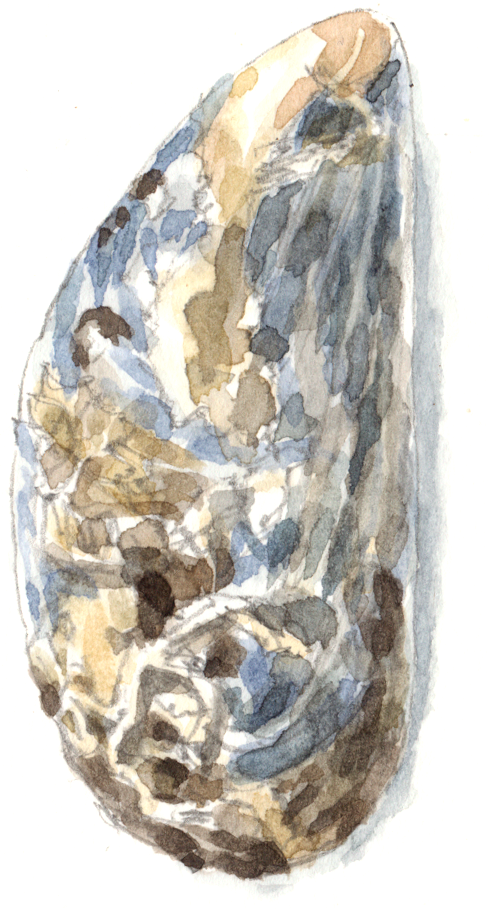
drawing a mussel shell

Two useful pieces of advice from Agathe Haevermans’ Drawing and Painting the Seashore:

  • If you’re drawing a bivalve shell life size, start by drawing the outline around the shell
  • Position yourself so that the light is coming from the top left, throwing a shadow to the right and below the shell
  • The shape of the shadow helps explain the shape of the shell – whether it’s convex or concave
mussel with keel worm

This mussel shell is encrusted with keel worm tubes. This is the left shell valve. The beak of the shell (top) is the anterior or front end from which the mussel’s foot emerges the its siphon emerges from the posterior end, at the bottom of my drawing.

Mussel and Barnacles

sketch

We did a bit of beachcombing along the strandline at Bridlington yesterday, between award-winning North Beach Fish & Chips and a champion roast latte at the local Costa.

mussel shell

Most of the mussel shells were small single valves, broken off at the wider end, but a few remained complete and still connected, including this one, partly encrusted by barnacles.

It’s a good time of year to go back to Agathe Haevermans Drawing and Painting The Seashore. It’s rare for me not to start a drawing in pen and ink, but, going back to Havermans’ examples, which are so evocative of summer strolls along the strandline, I thought that I’d try out her techniques.

The Triffids at Kew

Triffids on vacation.

My homemade card for Simon is my tribute to Gary Larson’s cartoon ‘The Holsteins visit the Grand Canyon’. Larson later wished he’d done a whole series and sent the family off to different locations, ‘such as Three Mile Island’.

I was tempted to replicate his gag of one of the Holstein calves ‘doing the old hoof-behind-the-head trick to its sibling’ but Larson concluded that this was just too subtle in the original and that most people (myself included) read it as one of the calves wearing a ribbon. Even knowing the artist’s intention, I still see it as one of the calves wearing a bow!

It’s 5 or 6 years since we last got to walk around Kew Gardens with our nephew Simon, so I hope we can join him again there before too long.

The Day of the Triffids

Published
Categorized as Drawing

Flag Iris

flag iris

Ducks and geese are beginning to gather again on the lake at Newmillerdam with a small flotilla of Canadas hanging around the war memorial. Three drake mallards surround a duck as she swims along with her ducklings following behind. One of the drakes mounts duck, grabbing her by the head and pushing her underwater. The ducklings form a tight circle and the duck manages to head for the cover of overhanging branches and extricate herself from the drake. The ducklings soon follow her.

Published
Categorized as Drawing

Pocket-sized Sketchbook

meadow
This meadow at the bottom of Hostingley Lane, Middlestown, was mainly mud by the end of a long, wet winter.

I usually say that May is my favourite month but cold weather has delayed blossom, birds and butterflies to such an extent that this year June is feeling as fresh as May, even though we’re not just nine days from midsummer.

Last page in my previous sketchbook, a seawhite A6 hardback.
salvia
Bumblebee on salvia. First sketch in my new Hahneműhle sketchbook.

I’m trying to focus on natural history this summer and to try and keep my main sketchbook – an 8×8 inch square spiral bound Amelie watercolour paper Pink Pig – as a nature journal but I do need a pocket-sized sketchbook for when we’re dashing about on errands, so this morning I started an A6 landscape Hahneműhle Watercolour book which is a sturdily bound hardback, so it slips into my little art bag more easily than a spiral bound version would.

There isn’t a handy bench in the library garden, so I’m trying a new pocket-sized (if you’ve got an extra-large pocket, that is) folding foam mat. It’s never going to replace my folding chair for comfort but it will just about do for ten minutes sitting on the concrete paving slabs, resting my back against one of the raised beds.

Fox Scat

It was a plastic plant label from our Musselborough leeks left lying in the middle of the back lawn that made me suspect that we’d had a fox in the garden. What else would take such an interest in a plant label?

Today we’ve got conclusive evidence of its presence with a dark, curled fox scat that has appeared overnight in the corner of the lawn by the pond.

Over the past week or so we’ve noticed a few fresh scrapes – about teacup size – mainly in the veg beds but also in the wood chip path.

One morning two weeks ago, shortly after we’d laid down a thick layer of wood chip on the path by my little meadow area, we saw a magpie eating carrion. We found the remains of a brown rat – by then just the vertebra were left, picked clean by the magpie – and we now think that it’s likely that this had been cached by the fox.