With my new sketchbook I’m broadening my outlook; it’s A5, 6 x 8 inches, as a opposed to 6 x 6, so there’s that extra space to breath. More depth, I hope, in dimension and in intention. And I’m feeling the urge to travel . . .


Richard Bell's nature sketchbook since 1998

With my new sketchbook I’m broadening my outlook; it’s A5, 6 x 8 inches, as a opposed to 6 x 6, so there’s that extra space to breath. More depth, I hope, in dimension and in intention. And I’m feeling the urge to travel . . .


I’ve been looking forward to doing the collage exercises in The Professional Step-by-Step Guide to Cartooning(Hissey & Tappenden). It’s so unlike anything that it would normally occur to me to do. The nearest that I get to collage in my sketchbooks is sticking in a ferry ticket or a tea-bag tag when we’re on holiday. I’ve stuck as closely as I could manage to Ivan Hissey’s sample artwork but to do it with his ease and panache I’d have to practice a bit more. Collage calls for forward planning, care and precision. Not my strongest points. You’ve got to look out for things like ragged edges – unless you intend to use a ragged edge – and splodges of glue.
And of course I’ll be in trouble next time Barbara needs to refer to the storage section of our Ikea catalogue!

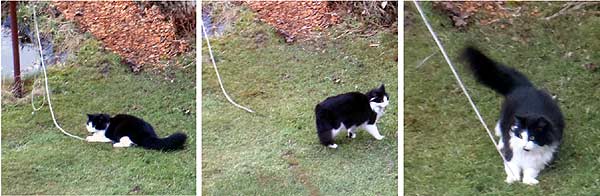
My priorities for the back garden might be attracting wildlife and growing vegetables but the ginger tom sees things differently:
This huge, fluffy ginger cat also enjoyed a spot of crazy breakdancing, pouncing this way and that on one of the veg beds like an overgrown kitten at play. The sparrows who normally hang around in the adjacent hawthorn hedge flew up in agitation, chirruping in alarm, apparently unsure what to make of this crazed predator.


I think that I’ll eventually be able to relax into a personal cartoon style but this drawing looks rather stilted as I was simultaneously following the style of the cartoon cowboy and the content of the equestrian portrait of Fairfax. The fanciful background sketch of Thornhill Hall (accidentally blown up at the end of Fairfax’s siege), which I’ve substituted for the wild west background of the cowboy, looks less self-conscious than the horse and rider.
I came across The Professional Step-by-Step Guide to Cartooning by Ivan Hissey and Curits Tappenden a couple of weeks ago and after the final push of getting my walks booklet into print, I thought that I deserved a bit of a change, so I’m going to have a few days off to go through some of the practice exercises in the book.
My main thing, of course, is drawing from nature, so why should I be interested in cartooning? This book is a practical introduction to drawing as a way of telling a story or communicating an idea, which is what I try to do in my publications. If drawing from nature was my sole concern, I could just as well present my drawings in isolation – framed on a gallery wall, for example – but invariably I present them as a sequence, along with varying amounts of text.
I’m hoping this book will make me rethink the way that I tell stories and communicate ideas in my publications.

I look foward to getting a bit more practice . . .

I launched Walks in Robin Hood’s Yorkshire at last year’s Festival. One of my first customers then was a woman from Nottingham who protested about any suggestion that Robin might be a Yorkshireman but I managed to talk her into buying a copy so I was delighted when – returning for this year’s festival – she said that she’d enjoyed reading it and she’d learnt a lot from it. I feel that’s quite an achievement!
It’s always a struggle to reach the deadline for this February event, following as it does the distractions of Christmas and, as often as not, some difficult weather for checking out the walks but it’s a good time of year to be starting afresh. Snowdrops, crocus and the first miniature daffodils are beginning to show and as we walked through the woods between showers this afternoon the leaves of bluebell, wild arum, golden saxifrage, dogs mercury and other woodland herbs were showing. I’ve got ambitious plans for drawing from nature and for book projects this year so hopefully I’ll be out there drawing the wild flowers as they appear throughout the season.
Here we are at the Admiral Benbow, the inn where young Jim Hawkins encounters Billy Bones and Blind Pew in Treasure Island. You might detect some echoes of last year’s Dame Dibble’s Dairy from Jack and the Beanstalk, in my sketch; this is because of my habit of recycling backdrops. Instead of starting the scene afresh, I’ve converted the half-timbered exterior of the dairy into the half-timbered interior of the inn.
This gave us time to flip the flats around this afternoon to quickly convert the sky blue scene of Jack’s Cloudland Castle into a tropical Treasure Island with palm trees, dunes and smouldering volcano (a detail that I don’t recall in the Robert Louis Stevenson original).
The first big production of the Horbury Pageant Players that I got involved in was Treasure Island, in 1967, but that was in the days when the Pageants prided themselves on never doing pantomimes so the scripts we used were on loan to us from the Mermaid Theatre, where Bernard Miles’ production had been a great success. In that version, comic genius Spike Milligan played Ben Gunn, the castaway with a fondness for cheese.
In our 1967 version, my younger brother Bill played the pirate who took Jim Hawkins’ kit on board the Hispaniola. Bill told me that one of the scripts had weird figures doodled all over it.
I never saw this script and all the whole batch were returned to the Mermaid after the production but I’m convinced that must have been Milligan’s script, annotated in characteristic style by him during rehearsals.
It would be a small treasure of Milligana if it had survived!

I think that I can see a patch of calm, clear water ahead but at the moment I really feel as if I’m swimming against a backwash and getting nowhere and that is reflected in this handful of sketches:

Finally, this afternoon, after a morning painting scenery and an afternoon at a farm shop event, I got the best part of an hour to sketch. As it was a Rhubarb Festival event the most appealing subject to hand was a basket of forced rhubarb and an example of the rootstock from which the shoots are grown, at this time of year, in total darkness to ensure an early crop, at a time of year when there is a break in the supply of soft fruits.

It’s been a wild day, wild but mild; this morning our neighbour’s three-year old boy got blown over in a gust on the way to school and the handful of stallholders who turned up at Ossett Market were sent home because of the danger of goods and even stalls being blown around. I felt particularly sorry for the fishmonger with all his fresh fish, having to pack up his van. We’ve had a lot of rain too and the Calder is running beige-brown and flowing up over the bridge piers but not quite at flood level yet.


It was so happy rolling on its back, pouncing and sitting with its ‘prey’ wrapped around its shoulder. Occasionally it did pause and look around as if thinking ‘This is silly, I hope no one is watching me.’ But it still couldn’t resist another mad tussle with the playful frayed end of the rope beckoning.
I’d love to have had time to make quick sketches but the last ten days have been taken up with preparations for Barbara’s mum’s funeral on Monday. I’m not going to really settle down until after there’s been that short ceremony of closure.
Over the past weeks and months I’ve slipped further and further behind with my latest booklet, the deadline for which is looming up in the next two to three weeks, but haven’t been able to make any real progress on it.
Thanks to our relaxed but relentless attention over the past few days to essential tasks, we’re hoping to get back out in the countryside next week, not to the wilder uplands of the Pennines that I’ve fondly imagined here, but at least we should manage to get out into the more homely farmland around Ossett to check out walks for my latest booklet. This is getting increasingly urgent as I’ve promised to have it ready to launch at the Rhubarb Festival in Wakefield at the end of February.
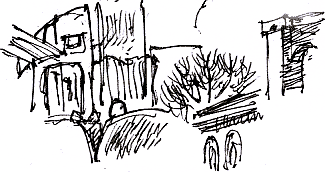
This pagoda reminds me of the ventilation towers on whisky distilleries, which I drew, years ago, for Steve Cribb’s book Whisky on the Rocks but I drew this from the Bakehouse Cafe in Ossett; this is the largest of three pagodas on the roof of a Victorian building which I believe was once the town’s Conservative Club but which is now a wine bar.

I’ve enjoyed having one or two comments to my postings, many thanks for those, but I’m having trouble with spam comments at the moment so I’ll probably have to turn off the comments (not sure how I do that at present!), to allow myself more time for the drawing and writing the diary itself. What a nuisance!