AFTER RESCUING this long-legged spider from the bath I’m afraid that I kept it hanging around in a bug box for a couple of days waiting until I had time to attempt to identify it.
It made a web too fine for me to see and hung there in its temporary quarters. I’d spotted it hanging down by the bathroom sink a day or two previously.
As this spider is brown and long-legged with no obvious pattern on its back I didn’t think that I stood much chance of identifying it but that is where having a shelf full of field guides proves helpful. I soon found it in Paul Sterry’s Collins Complete Guide to British Garden Wildlife.
Its the Daddy-long-legs spider Pholcus phalangioides, an introduced species which has spread in Britain thanks to central heating. Sterry states that it cannot survive if the temperature drops below 10°C so instead of realeasing it outdoors I release it at the back of the garage by the central heating boiler.
I wonder how long it will be before it blunders into the bath again.
The photograph in Garden Wildlife shows a ‘Mummy-long-legs’ surrounded by her brood of rather cute spiderlings. The bands around the joints on her legs which I’ve shown are clearly visible.
I think that the spider that I drew must have been a female too as she has small palps (the ‘feelers’). Male spiders usually have palps like furry boxing gloves, which are used in mating.
It is also sometimes known as the skull spider its face bears a cartoonish resemblance to a human skull.
GEORGE AND SARAH ANN are back from their makeover and it’s been quite a transformation. Robin Taylor has cleaned them, removing as much of the old discoloured varnish as he could without damaging the paintwork. He’s touched up the blemishes (the ‘bullet-wound’ on George’s forehead has healed up nicely) and finally he applied a resin varnish which has restored the richness and depth of the colour.
I’m impressed by this detail of embroidery on the sofa arm in the portrait of Sarah. These are painted photographs so I’m not sure whether this has been meticulously painted or whether it is the original photograph showing through a transparent glaze of oil paint.
Although today we’d see basing a portrait so directly on a photograph as ‘cheating’ at the time this was a way of embracing a new technology. Robin, who was as surprised as we were by how well these battered old paintings have responded to restoration, describes the painting as a superior job.
The paintings are on card with a sheet of wood backing them. I was rather hoping that Robin would find an old document stuffed in the back of the painting. He tells me that he occasionally finds a page from a newspaper added as packing behind a painting in a frame.
The printed label on the back of each portrait states that Geo. Wilkinson & Son of 98 Devonshire Street, Sheffield (two doors down from Westfield Terrace) offer the following services:
Oil Paintings, carefully cleaned, re-lined and restored
Water Colour, and other drawings cleaned and mounted
Engravings, cleaned – mildew and damp stain effectively removed
The Bride in Black
I’m sorry that photographer and picture restorer George Cecil Wilkinson and his oil painter colleague J H Ainley aren’t still around to see how well these portraits are looking a century and a quarter after they produced them.
My mum tells me that George Wilkinson married a cousin of her dad’s and I believe that Ainley too was either a friend or in-law. They were to play a part – a controversial part – in the story of my family at a later date.
I was wondering why Sarah Ann should be wearing black. Had she recently lost a member of her family and gone into mourning. Apparently not; this was before a white wedding became the norm and black was often worn by brides. George and Sarah were married in the mid 1870s but, if they were photographed at the time, it seems that the paintings were produced some years later as the Geo. Wilkinson label reads ‘established 1879’.
I’m taking these two portraits as a starting point, a re-starting point, for my family tree research and I’m going to put together a little biography of George, a Sheffield spring-knife maker, and his wife Sarah Ann who started her working life as a home help aged 11. Sarah, I feel is a key characters in the story of that branch of the family. She was born when the industrial revolution was still at its height in the city and she lived long enough to get caught up in the Sheffield Blitz.
Song of the Slave
She reminds me in this portrait of one of the young women who Mrs Hudson ushers into the consulting room at 221b Baker Street at the start of a baffling case for Sherlock Holmes and Doctor Watson. But this time it’s up to me to observe the details and to attempt to piece to together something of the story of her life.
Is there some significance in the way she is holding her pocket watch?
Sarah’s fingers, my mum tells me, were as chubby as shown as a result of all her domestic duties but she was taught to play the piano by one of the families she worked for. One of the pieces that she learnt was The Song of the Slave. We still have the sheet music. This brings home the historical context; born on Boxing Day 1850, Sarah was learning to play the piano in the days immediately before the American Civil War and the subsequent emancipation of the American slaves.
George doesn’t give much away in his sober Sunday best suit but I’m looking forward to hearing what my costume expert friends can tell me about him.
The candid camera photograph (which I’ve already featured in this diary) of George that is son took around 1900 is more revealing of his background and domestic circumstances.
I MADE this zero calorie bar of chocolate using a recipe from Chipp Walters’ book Create 3D like a Superhero!, an entertaining introduction to the Vue 3D modelling program. A new – and free to use – version Vue Pioneer 11 is now available and having downloaded it I was inspired me to pick up the book and continue where I left a year ago.
My last Vue creation was Chipp’s Dolphin mini-submarine, but I remember struggling with the paint-shop part of the tutorial!
IT MIGHT BE about a month late thanks to the cold, sometimes snowy weather but at last there’s a clump of frogspawn in the pond with at least 14 frogs, most of them gathered around the clump which is on the sunnier, shallower side of the pond.
IT’S UNUSUAL to be able so see your Victorian ancestors in colour but these two portraits that have been stored away since my mum inherited them in the 1960s give me an opportunity to do that. I’ve decided that, whatever their merits as paintings, it is worth giving them a new lease of life because they’re such central characters in the family sage that I’ve been unfolding in my genealogical research re so I’ve taken them to Robin Taylor in Wakefield for restoration.
Robin tells me that they’re painted photographs. The budget version of this would be a photograph with some of the features such as eyebrows picked out in charcoal by the photographer so these fully overpainted photographs would have been a more expensive option.
These aren’t wedding portraits because George and Sarah were married in the 1870s and the label on the back of the portraits suggests that they were photographed, then painted, in the 1880s.
THE WARMER WEATHER over the weekend has at last encouraged the frogs to return to the pond. There are at least nine, but probably more, of them lined up around the edges. These will be males waiting for the females to arrive.
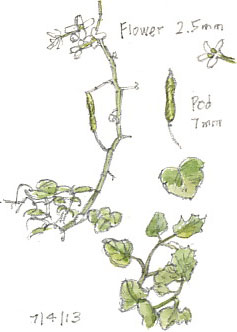
HAIRY BITTERCRESS, Cardamine hirsuta, growing in the shady flower bed by the front door, is one of those little green jobs, a garden weed that looks so nondescript that you might think that it would be impossible to identify it.
The four-petalled cross-shaped flowers show that it’s a crucifer, a member the cabbage, cress and mustard family, formerly the Cruciferae but now known botanically as the Brassicaceae family.
The leaf-shapes and the sausage-shaped seed-pods help me narrow it down to hairy bittercress and a hand lens reveals that, as the species name hirsuta suggests, the stems and the backs of the leaves are covered in little hairs.
You also need a hand lens to spot that its flower has four stamens. This distinguishes hairy bittercress from a similar looking species, the wavy bittercress, Cardamine flexuosa, also known as greater bittercress.
AT LAST the frogs are back, well two of them, but when I spot them this afternoon they’re actually making their way out of the pond. It’s warmer today but it’s likely that it’s going to turn cold again so perhaps it is as well that no spawn has appeared as it could still at this late stage run the risk of getting frosted.
Two pied wagtails flitted about on the terra cotta tiles of the house roof opposite in this morning’s sun, which must have been enticing overwintering insects to emerge from the nooks and crannies. The wagtails briefly mate, or attempt to mate.
Today’s loaf is my attempt at at Paul Hollywood’s ale and rye bread. It proves quite a workout as the dough, to which you add a couple of teaspoons of black treacle, proved to be stubbornly sticky. Perhaps the froth on pale ale caused me to underestimate how much liquid I was adding.
But it’s got lots of character and flavour and it looks more or less like the one in the book.
I FEEL BAD walking out to discourage the pair of mallards from making themselves at home in our pond but mallards are doing fine on the river, lakes and dams locally but I’m getting increasingly worried about our local frogs. Will we see them return when the warm weather reaches us this weekend.
THE CLOCKS went forward at the weekend so we’re now into British summertime, despite the low temperature and the strips of snow lingering on the hills.
It’s 8pm and as the light fades there’s a lot of posturing and puffing up of plumage as the back garden blackbirds emphasise their claims to the lawn. A single male claims the flower border while a resident pair forage around the shed and the herb bed opposite.
The males play cat and mouse, mirroring each other’s postures but keeping a few paces away from each other on a band of disputed territory along the front of the herb bed and down to the pond.
The bluster doesn’t bubble over into outright aggression and the shed pair fade away beyond the hedge as dusk drains away the light. They’ll be bursting into song to establish their claims again at dawn.
 AFTER RESCUING this long-legged spider from the bath I’m afraid that I kept it hanging around in a bug box for a couple of days waiting until I had time to attempt to identify it.