
This Barn Owl was found lying by the side of the M1 near junction 40 earlier this week. A member of the Wakefield Naturalist’s spotted it and brought it to the meeting on Tuesday. Sadly, this if a first; at the meetings of the Wakefield Naturalists’ Society that I’ve attended over the last 40 years, I don’t ever remember anyone bringing in a dead bird but this was apparently a regular feature of the society’s meeting in the Victorian period in the bad old days when one of the axioms of keeping biological records was ‘what’s hit is history, what’s missed is mystery’. Even some of the founding fathers of conservation like Audubon used the gun to collect huge numbers of birds, and not just strictly for reference purposes when illustrating his Birds of America, he apparently enjoyed the sporting aspect of shooting wild birds.
There’s a record of an Otter which was shot on the Calder at Stanley on 3 February, 1869. Rather worryingly there’s a note in the Wakefield Naturalists’ Society Annual Report for 1883 (illustrated here with an engraving by Thomas Bewick, or one of his followers):

Otter – Lutra vulgaris. Several have been obtained.
The Wakefield Naturalists’ Society was founded in 1851, ten years before the Yorkshire Naturalists’ Union, which celebrates its 150th anniversary with a conference on The Ever-changing Flora and Fauna of Yorkshire at Garforth on 19 March this year. Obviously there had to be a network of naturalists’ societies before a county-wide Union could be formed.
Coming back to the unfortunate Barn Owl; it’s hunting habits, flying low over open, scrubby grassland, in the half-light of evening are sooner or later going to put it on a collision course with motorway traffic. Low Laithes golf course provided a hunting territory for Barn Owls as their numbers began to recover locally in the 1980s. They’re continuing to spread around Anglers Country Park today.
 Appropriately the place name Laithes comes from the Viking word for barn. My Walks around Ossett follow circular routes around the town from Mitchell Laithes in the south-east to Low Laithes in the north-west.
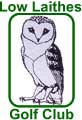
 When I was checking out the Low Laithes walk for the booklet, I came across a familiar-looking image of a Barn Owl. Flags and signs at Low Laithes golf course are emblazoned with the owl logo I drew for them back in the late 80s or early 90s. It’s even been carved in bas-relief in sandstone by the entrance gates; the first time I remember anything of mine being carved in stone.
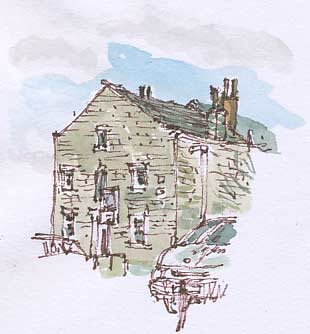
 End of terrace on the junction of New Street and Prospect Road, Ossett, drawn during a coffee break at Cafe Vie.